
Someone searching for signage approval in Dubai is likely a new business owner. They are ready to open their shop but are stuck on permits. Nobody told them this step even existed.
They have probably already called a signage company in Dubai. The company quoted a price but gave no clear answers on approvals. Now they are confused, worried about fines, and unsure where to start.
This article explains exactly how signage approval works in Dubai. It covers which authority to contact, what documents to prepare, how much it costs, and how long it takes. By the end, you will know every step required to legally approve and install your sign.
What Is Signage Approval and Why Do You Need It?
Signage approval is an official government permit that allows you to legally install a sign on your business premises in Dubai. It is issued by authorities like Dubai Municipality, DDA, or Trakhees, depending on your business location.
Every business installing a commercial sign in Dubai needs this permit. This includes shop owners, restaurant operators, corporate offices, and contractors installing signs on behalf of tenants.
Under the UAE signage law, no commercial sign can be installed without a valid advertising permit. Your sign must also match the name on your trade license exactly. Installing without approval violates Dubai’s outdoor advertising regulations.
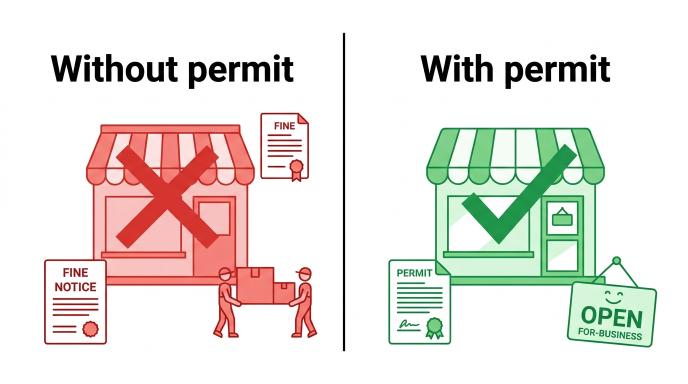
Businesses that skip this step face 3 consequences:
- Fines from Dubai Municipality
- Forced removal of the sign at the owner’s expense
- Delays to business license renewal
Which Authority Approves Your Signage in Dubai?
The authority that approves your signage depends entirely on where your business is located in Dubai. There is no single body handling all signage permits. Mainland businesses, free zone companies, and roadside advertisers each fall under a different jurisdiction.
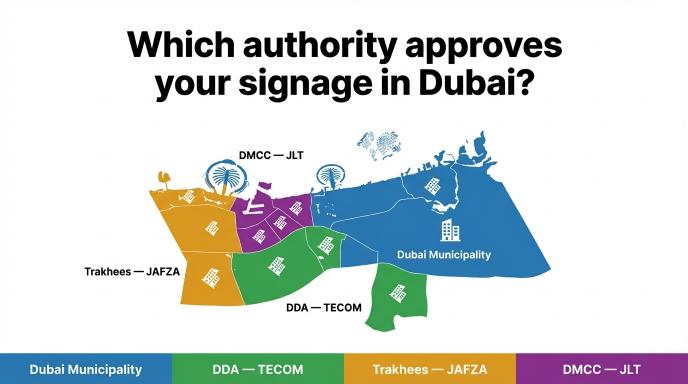
There are 5 main authorities that handle signage approvals in Dubai:
Dubai Municipality
Dubai Municipality approves signage for businesses on mainland Dubai. This covers commercial areas including retail shops, restaurants, and offices outside free zones. Applications are submitted through the Smart Advertising Single Window portal at smartadv.dm.gov.ae. Businesses in free zones do not apply here.
Dubai Development Authority (DDA)
DDA approves signage for businesses inside the TECOM free zone areas. This includes Dubai Media City, Dubai Internet City, Dubai Studio City, and Dubai Knowledge Park. Applications are submitted through the Smart Advertising Single Window portal, but the DDA reviews and issues the permit directly.
Trakhees
Trakhees handles signage approvals for businesses in DP World-managed zones. This covers JAFZA, Dubai South, and Palm Jumeirah. Businesses in these zones apply directly to Trakhees and cannot use the Dubai Municipality portal.
DMCC
DMCC approves signage for businesses in Jumeirah Lakes Towers (JLT). DMCC follows its own signage and advertising guidelines. Tenants in JLT must get approval through the Concordia system before installing any sign.
RTA
The Roads and Transport Authority approves signage near roads, highways, and public transport areas. This includes roadside billboards, unipoles, and digital displays visible to drivers. RTA approval is required in addition to your primary authority permit when your sign faces a public road.
What Types of Signage Need a Permit in Dubai?
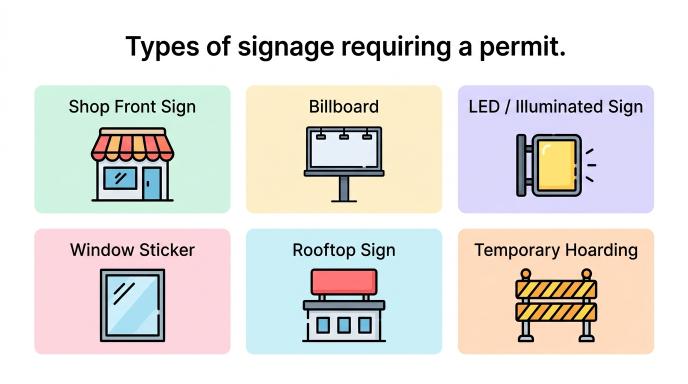
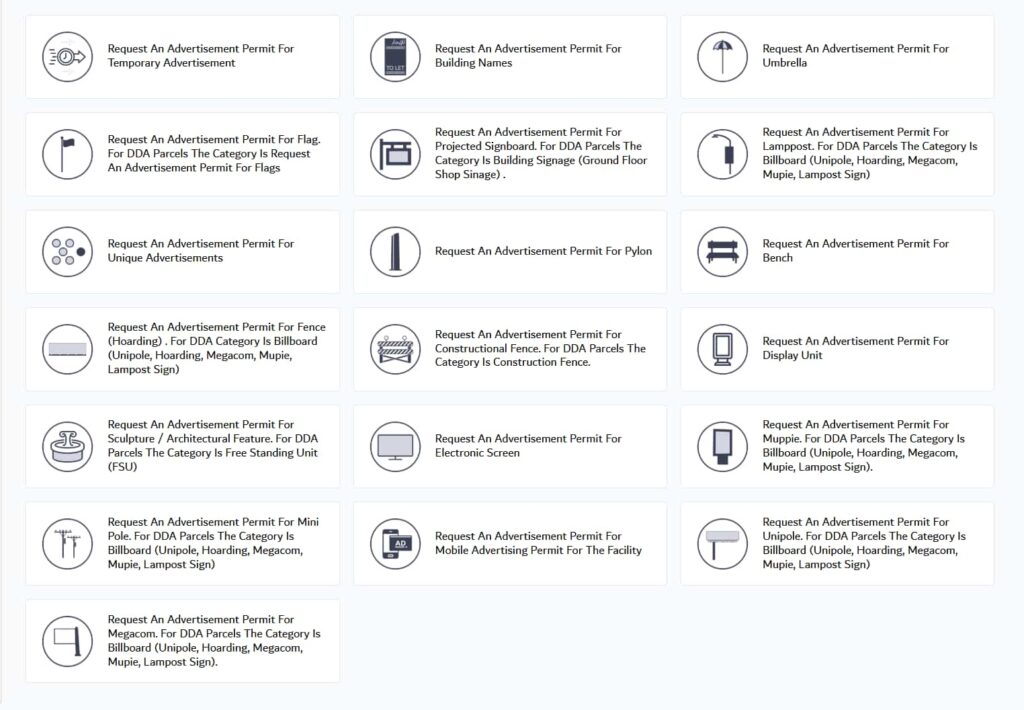
Almost every type of commercial sign in Dubai requires a permit before installation. Below are the main categories.
Permanent Signage: Fixed signs attached to your premises, including shop front signs, rooftop signs, parapet signs, and building wraps, all require a full advertising permit.
Outdoor Advertising Structures: Large formats such as billboards, unipoles, and hoardings require a permit from the relevant authority. Roadside structures also require separate RTA approval if facing a public road.
Illuminated and Digital Signs: LED signs, lightbox signs, and digital signage displays all require a permit. Signs fixed above 2.5 meters also require a risk assessment and structural review.
Smaller-format signs: Window stickers, flags, and free-standing units (FSUs) also need approval. A window sticker permit costs AED 1,000 per year. A rooftop sign costs AED 2,500 per year.
Temporary Signage: Construction hoardings and inflatable or floating signage require a permit. Under DDA rules, these fall under a fee category of AED 5,000 per year.
Flyer Distribution: Distributing flyers in Dubai requires a separate flyer distribution permit from Dubai Municipality. It is treated as a different advertising activity from signage and needs its own approval.
Documents You Need for Signage Approval in Dubai
Every signage application in Dubai requires a core set of documents regardless of sign type or authority. Missing even 1 document is the most common reason applications are rejected.
Core Documents
Every applicant must submit these 6 documents:
- Trade license copy
- Location map and site plan
- Photograph of the existing building facade
- Colored and scaled drawing of the proposed sign, including dimensions, cross-section, and material specifications
- Mock-up perspective showing the sign on the building
- NOC from the plot owner or landlord
All documents must be uploaded in PDF or JPEG format through the application portal.
When Structural Documents Are Required
Structural drawings and calculations are required when your sign meets any of these 3 conditions:
- Fixed above 2.5 meters from ground level
- Height dimension above 2.5 meters
- Electrical or illuminated sign
A risk assessment and risk compliance method statement must also be submitted. Electrical signs additionally require a DEWA NOC before installation.
Sector-Specific NOCs
Depending on your business type, an additional NOC is required:
- Real estate advertising: NOC from RERA
- Entertainment events: NOC from DTCM
- Clinics, hospitals, health products: NOC from DHA
- Educational services: NOC from KHDA
Tenant vs Owner Differences
Tenants must submit a contractor appointment letter and an Ejari tenancy contract in addition to all core documents. Owners applying directly do not need these. The landlord NOC must be obtained before submission. Without it, the application will not be processed.
Step-by-Step: How to Apply for Signage Approval in Dubai
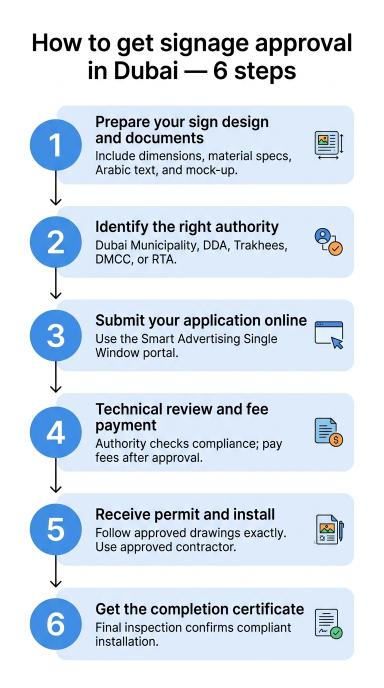
Signage approval in Dubai follows a 6-step process from design preparation to final completion certificate. Most authorities process applications through the Smart Advertising Single Window portal online.
Step 1 – Prepare Your Signage Design and Documents
Prepare a complete sign design with all required specifications before starting your application. Include exact dimensions, material specs, cross-section details, and a building facade mock-up. Arabic text must appear on the sign and be correctly sized. Incomplete designs are the leading cause of rejection.
Step 2 – Identify the Right Authority and Portal
Submitting to the wrong authority results in rejection without review. Use this guide:
- Mainland Dubai: Dubai Municipality
- TECOM free zone: DDA
- JAFZA or Dubai South: Trakhees
- JLT: DMCC
- Sign facing a public road: RTA approval is also required
Step 3 – Submit Your Application
Submit through the Smart Advertising Single Window portal at smartadv.dm.gov.ae for Dubai Municipality and DDA applications. Fill in applicant information, owner and tenant details, contractor information, parcel ID, and plot number. Upload all documents in PDF or JPEG format. An email confirmation is sent once received.
Step 4 – Technical Review and Fee Payment
The authority reviews your sign for compliance with size, material, structural, and design requirements. Feedback is sent by email if revisions are needed. Once approved, pay fees through the online payment portal. Every transaction includes AED 10 Knowledge Dirham and AED 10 Innovation Dirham.
Step 5 – Receive Your Permit and Install
Your advertising permit is issued after payment confirmation, and installation can begin. Installation must follow approved plans exactly. Any deviation requires a new submission. Work must be carried out by an approved contractor.
Step 6 – Get the Completion Certificate
After installation, request a final inspection to obtain the completion certificate. This confirms the sign was installed in compliance with approved drawings. Structural signs require a separate Advertising Structural Completion certificate. A permit is not fully closed without this certificate.
How Much Does Signage Approval Cost in Dubai?
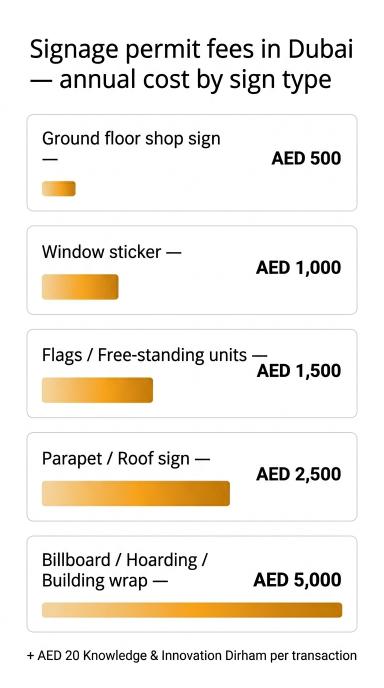
Signage approval fees in Dubai range from AED 500 to AED 5,000 per year, depending on sign type and authority. Below is a full breakdown.
DDA Fee Breakdown by Sign Type
DDA charges a fixed annual fee per sign category:
| Sign Type | Annual Fee (AED) |
| Ground floor shop signage | 500 |
| Window sticker | 1,000 |
| Flags / Free-standing units (FSU) | 1,500 |
| Podium parapet sign / Roof parapet sign | 2,500 |
| Billboard, unipole, hoarding, building wrap, rooftop sign, bridge banner, roundabout branding | 5,000 |
Every DDA transaction includes an additional AED 20 in government charges: AED 10 Knowledge Dirham and AED 10 Innovation Dirham.
Dubai Municipality Fees: Dubai Municipality calculates fees based on the sign’s square footage. Larger signs cost more. Exact figures depend on the dimensions submitted during the application.
RTA Fees RTA fees apply separately when your sign faces a public road. These are charged in addition to your Dubai Municipality or DDA permit fee and vary by sign size and location.
Fabrication and Contractor Costs: Government permit fees cover approval only. Fabrication and installation costs are separate and vary by sign size, material, and complexity.
Estimated Total Budget For a standard ground-floor shop sign in a DDA zone, the minimum government fee starts at AED 520, including charges. Dubai Municipality sign costs vary based on square footage. Budget separately for fabrication and contractor fees on top of permit costs.
How Long Does Signage Approval Take in Dubai?
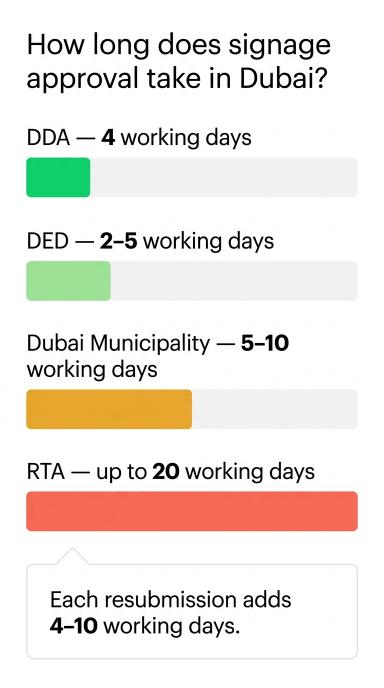
Signage approval in Dubai takes between 4 and 20 working days, depending on the authority processing your application.
| Authority | Processing Time |
| DDA | 4 working days |
| DED | 2 to 5 working days |
| Dubai Municipality | 5 to 10 working days |
| RTA | Up to 20 working days |
These timelines apply to complete applications only. A single resubmission adds 4 to 10 working days to your total wait time.
4 Tips to Avoid Delays
- Submit all documents in PDF or JPEG format before applying
- Include Arabic text in your design before submission
- Confirm the correct authority for your location before applying
- Respond to authority feedback within 24 hours to stay in the review queue
Key Rules Your Signage Must Follow
Every sign installed in Dubai must comply with the UAE advertising law before a permit is issued.
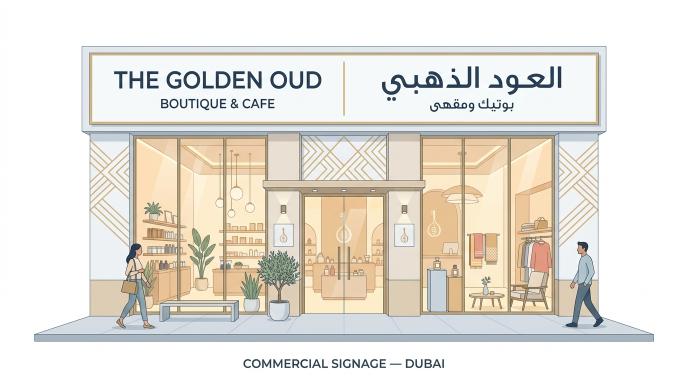
Arabic Text Is Mandatory. Every commercial sign must display Arabic text alongside English. Arabic is typically placed on the right or top of the sign. Signs submitted without Arabic text are rejected at technical review.
Name Must Match Your Trade License. The business name on your sign must be identical to your trade license name. Abbreviations, logo-only designs, and spelling differences are grounds for rejection.
Size Must Fit Your Building Frontage Sign dimensions must be proportional to your shop or building frontage. Signs cannot exceed the width of your facade. Rooftop and parapet signs have additional height restrictions set by Dubai Municipality and DDA.
Lighting and Illumination Rules: Illuminated signs must not cause glare to neighbouring properties, pedestrians, or drivers. LED signs and lightbox signs must comply with brightness limits under outdoor signage regulations in Dubai.
Safety and Obstruction Rules Signs must not block emergency exits, fire safety equipment, or public walkways. Signs above 2.5 meters require a structural review and risk assessment. No sign can encroach on public space beyond the plot boundary.
How to Renew Your Advertising Permit in Dubai
Advertising permits in Dubai are valid for 1 year and must be renewed annually before the expiry date.
When to Renew DDA and Dubai Municipality both issue permits valid for 1 year from the approval date. There is no automatic renewal. Track your expiry date and submit before it passes.
Renewal Steps: Renewal follows 3 steps:
- Log in to the Smart Advertising Single Window portal
- Select your existing permit and submit a renewal application with updated documents
- Pay the renewal fee for your sign category
If your sign design, size, or location has changed, submit a new application instead of a renewal.
What Happens If Your Permit Lapses? A lapsed permit is treated the same as having no permit. It exposes your business to fines and risks of forced removal. Reinstatement requires a full new application, adding cost and processing time.
Common Reasons Signage Applications Get Rejected
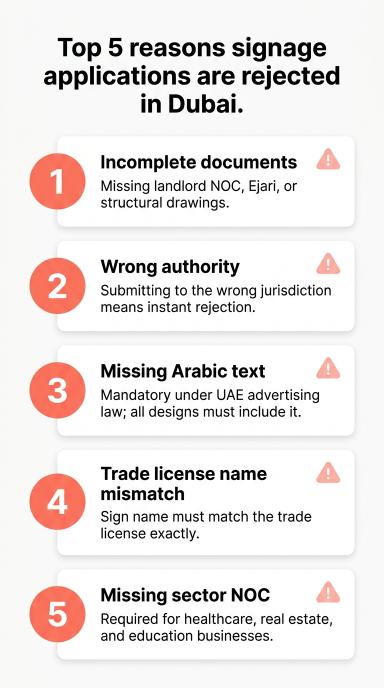
Most rejections in Dubai are caused by avoidable errors made before submission. These are the 5 most common reasons:
- Incomplete Documents — Missing items like the landlord NOC, Ejari, contractor appointment letter, or structural drawings result in immediate rejection.
- Wrong Authority — Submitting to the wrong authority means instant rejection without review. Confirm your jurisdiction before applying.
- Missing Arabic Text — Any design without Arabic text fails at technical review. It is mandatory under UAE advertising law.
- Trade License Name Mismatch — The name on your sign must match your trade license exactly. Abbreviations and spelling differences are grounds for rejection.
- Missing Sector NOC — Businesses in healthcare, real estate, and education must include a NOC from DHA, RERA, or KHDA, respectively.
How to Resubmit: Correct all flagged issues and resubmit through the same portal in a single submission. Each resubmission restarts the review clock, adding 4 to 10 working days depending on the authority.
What Happens If You Install Signage Without Approval?
Installing signage without approval in Dubai results in 3 consequences: fines, forced removal, and legal action.
Fines are issued by Dubai Municipality based on sign type, size, and duration installed without a permit. Authorities can order immediate removal at the business owner’s expense. If not removed on time, authorities remove it and bill the cost to the business.
If you have already installed without approval, apply immediately. A proactive application shows compliance intent and may reduce the penalty.