
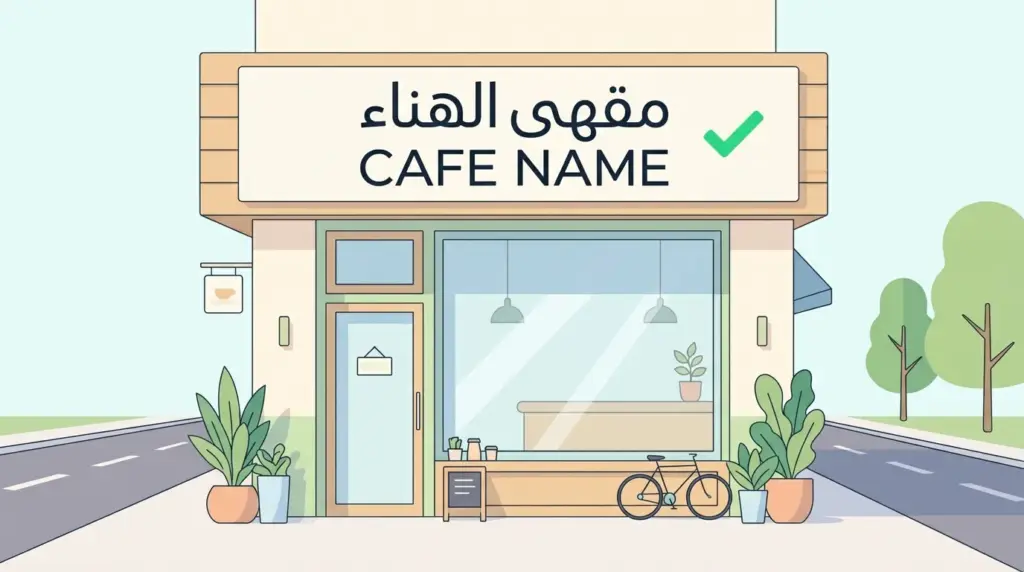
Retail signage is the set of signs a store uses to attract shoppers, guide them through the space, and influence what they buy. It works in stages: exterior signs pull people in, wayfinding signs move them through the store, and POP signs convert them at the shelf. Research shows 76% of consumers have entered a store based on its signs, and over 75% say signage has influenced a purchase decision. In Dubai, retail signs on shopfronts must be bilingual in Arabic and English, with Arabic placed above the English text.
Retail signage is any sign used inside or outside a shop, restaurant, or retail space to attract customers, guide them, share product information, and drive sales. It is sometimes described as a silent salesperson: it communicates with every shopper in the store at once, at every moment, without staff involvement. In Dubai’s competitive mall and street-level retail environment, where a single location can see thousands of visitors a day from over a hundred countries, the clarity and quality of that silent communication has a direct commercial impact.
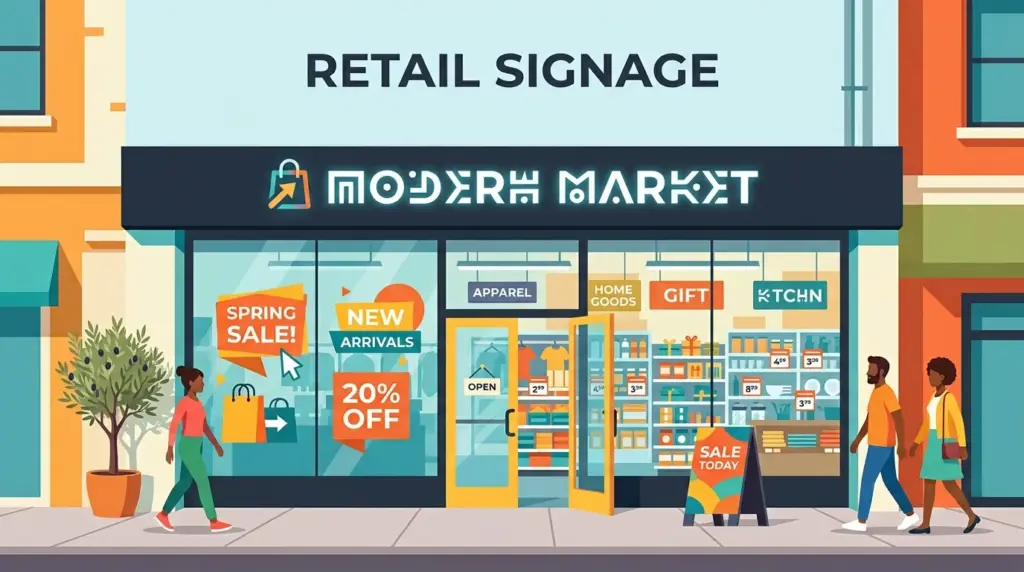
What Is Retail Signage?
In-store signage covers the full set of visual communication a business uses in and around its space. That ranges from the lit channel letters on the shopfront that a driver sees from the road, to the shelf talker that catches a shopper’s eye at the moment they decide what to pick up.
What makes in-store signage distinct from other signage types is its job: it is not just identifying a room or warning of a hazard. It is working to influence a commercial outcome at every point in the shopping journey. A well-planned system does this without friction, so the shopper feels guided, informed, and interested rather than sold to.
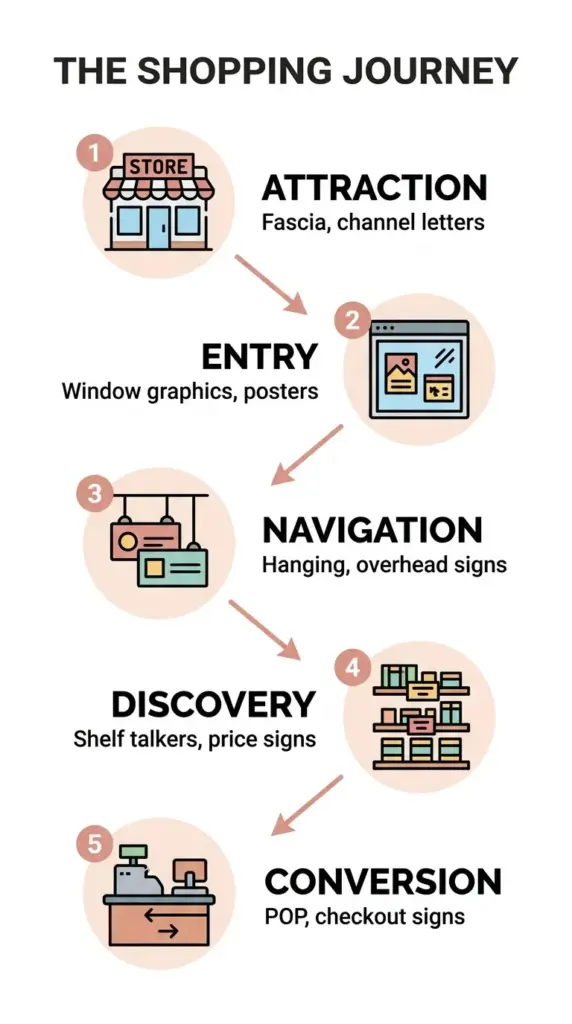
How Retail Signage Maps to the Shopping Journey
This is the framework that explains why in-store signs work as a system rather than a collection of individual pieces. Each stage of a shopper’s journey has a different need, and the right sign at the right stage is what converts a passer-by into a buyer.
Stage 1: Attraction (Exterior and Storefront)
The first job at the attraction stage is to be noticed from the street or mall corridor. Exterior and storefront signs identify the business and give a passer-by a reason to stop. Research from VistaPrint found that 76% of consumers have entered a store they had never visited before because the signage caught their eye. This is the most valuable sign in the system because it is working before the shopper has decided to enter at all.
At this stage: fascia signs, channel letters, window graphics, and banners do the work.
Stage 2: Entry (Window and Entrance)
Once a shopper is at the threshold, window and entrance signs give them a reason to commit. A window promotion, a new-arrival banner, or a “sale on now” poster converts the moment of hesitation at the door into a step inside.
At this stage: window graphics, posters, entrance signs, and digital screens near the door.
Stage 3: Navigation (Wayfinding and Overhead Signs)
Inside the store, the first thing a shopper needs is orientation. Hanging aisle signs and overhead category markers tell them where things are so they can move directly toward what they want. Shoppers who cannot find what they came for leave. Shoppers who move efficiently through a well-signed store stay longer and buy more.
At this stage: hanging signs, overhead category signs, directional floor graphics, and department markers.
Stage 4: Discovery (Shelf, Aisle, and Product Signs)
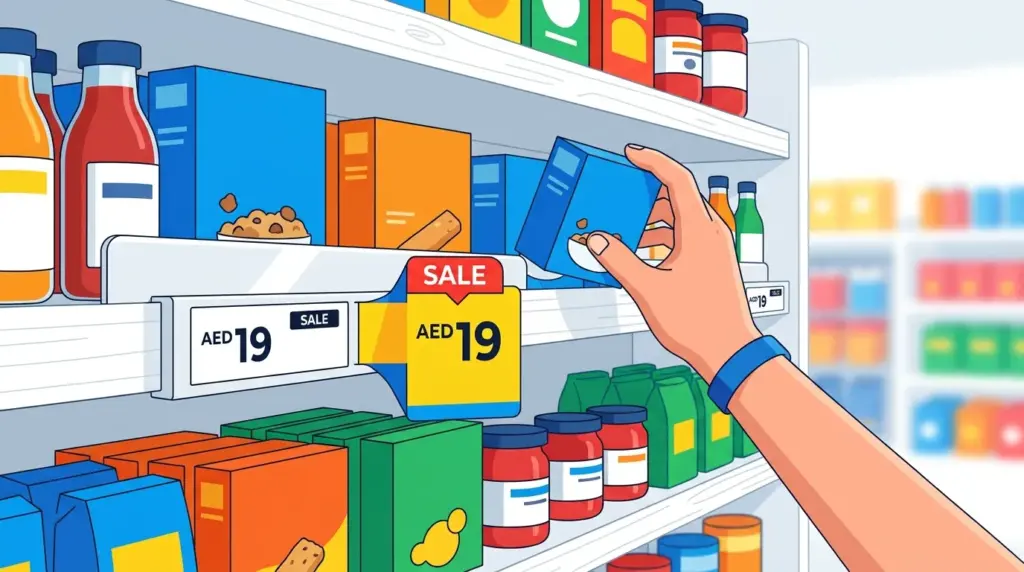
At the product level, signs influence which item a shopper notices and considers. Shelf talkers, price signs, and promotional callouts at eye level at the shelf edge are often the last communication a retailer has with a shopper before the decision is made. A Mood Media survey found that 58% of shoppers actively notice in-store displays, and nearly half of those say those displays influenced their purchase.
At this stage: shelf talkers, price tags, aisle violators, product information signs, and display stands.
Stage 5: Conversion (Point of Purchase and Point of Sale)
POP signs (point of purchase) sit near the product. POS signs (point of sale) sit near the checkout. Both work on the purchase decision and the impulse buy. Highlighting a promotion, a bundle, or a complementary product at these two points drives both basket size and conversion. Research shows that 62% of shoppers make spontaneous purchases, with a significant share of those triggered by in-store displays and checkout-area signs.
At this stage: POP displays, checkout-area promotions, counter signs, and digital menu or pricing boards.
Types of In-Store Signs
Mapped to the journey above, the main types are:
- Storefront and fascia signs. The lit or printed sign above a shop entrance, carrying the brand name and making the business identifiable from a distance.
- Window graphics. Printed or cut vinyl on glass, promoting offers, new arrivals, or brand messaging at the threshold.
- Hanging and overhead signs. Ceiling-mounted signs naming departments and aisles so shoppers can scan the store and head to the right section.
- Directional and floor graphics. Arrows, floor decals, and route markers that steer movement through the space.
- Shelf talkers and aisle signs. Small signs clipped to the shelf edge or projecting into the aisle to highlight a product, price, or promotion at the moment of decision.
- Price tags and product signs. Clear pricing and product information that reduce hesitation and speed up buying decisions.
- Promotional and seasonal signs. Sale banners, offer posters, and event signage that drive urgency.
- Display stands and POP units. Branded fixtures near a product or at checkout that draw attention and encourage impulse picks.
- Digital retail screens. LED displays that show changing promotions, video content, or menu boards, updateable without replacing the sign.
For a fuller breakdown of every sign format and material, see our guide on the types of signs and our guide on signage materials.
The Functions of In-Store Signs
Each sign type carries one or more of these functions:
- Driving foot traffic. Exterior and window signs bring in shoppers who might otherwise walk past.
- Navigation and wayfinding. Directional and overhead signs move people through the store without confusion.
- Influencing purchase decisions. POP and shelf-edge signs push a product at the decision moment.
- Triggering impulse buys. Checkout and promotional signs add unplanned items to the basket.
- Cross-selling. Signs that highlight complementary products increase basket size.
- Branding. Consistent typography, colour, and logo across every sign builds the brand in the shopper’s mind throughout the visit.
- Communicating policies and information. Returns policies, opening hours, and service details reduce staff questions.
- Legal compliance. In the UAE, specific signs are required by law, from safety notices to bilingual identification.
The Business Case: Benefits Backed by Research
The business case is well-supported by shopper behaviour research:
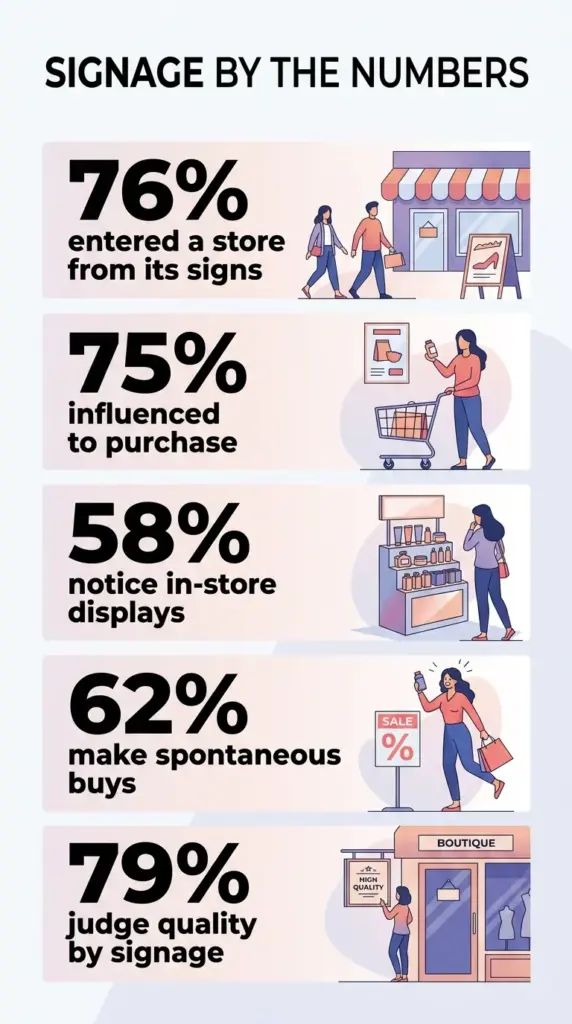
- 76% of consumers have entered a store they had not planned to visit because the signage caught their eye.
- 75% of shoppers say signage has led them to make a purchase.
- 58% of shoppers actively notice in-store displays, and nearly half of those say their buying decisions were influenced by them.
- 62% of shoppers make spontaneous purchases, with a meaningful share of those driven by displays and shelf-level signs.
- 79% of consumers believe a store’s signage reflects the quality of its products and business.
Beyond those direct sales effects, retail signage reduces the workload on staff (who spend less time giving directions and answering basic questions), makes the store feel organised and trustworthy, and keeps the brand consistent across every surface a shopper touches.
Shopping Signage in Dubai: Rules and Context
Dubai’s retail environment is one of the most competitive and demanding in the world for signage.
The mall context. Dubai Mall alone receives over 100 million visits a year, making it one of the busiest retail environments on earth. In that setting, a sign has fractions of a second to communicate before a shopper’s attention moves on. Clarity and bilingual legibility are not optional: a shop serving a base of 200-plus nationalities in a single location needs signs that work in Arabic and English simultaneously, and that read at speed for a shopper who has never been in the store before.
The 2026 DET rules. The Department of Economy and Tourism updated its shopfront signage requirements in 2026. The key rules retail businesses face are: one trade name per facade, Arabic text placed above the English text (not just alongside), Arabic must be a linguistically correct translation rather than a phonetic transliteration, and the name on the sign must match the DET trade licence exactly. Signs submitted without correct Arabic text are rejected at technical review.
Mall tenant design manuals. Most major malls in Dubai operate a design manual that governs every sign a tenant can install inside or outside their unit. These manuals often specify the exact font, colour system, and sign locations for the tenancy. They are separate from and additional to the DM permit, and discovering them after fabrication is a common reason for complete redesigns. Landlord NOC approval comes before the authority submission.
Interior signs visible from outside. A large lightbox or illuminated panel placed directly against the shopfront glazing is treated as an exterior sign for permit purposes, not an interior one. This catches many tenants who assumed internal signage needed no approval.
Temporary promotional signs. Sale banners and promotional signage on a shopfront need a temporary permit with a defined display window. Leaving promotional signs up past their permitted period is actively enforced.
Working With Bab Al Mashriq
Bab Al Mashriq designs, manufactures, and installs retail signage across Dubai and the wider UAE, from shopfront fascia and channel letter signs to window graphics, hanging signs, display stands, and interior branding. Fabrication is in-house, and Dubai Municipality and DET approvals are handled as part of the order, with the Arabic-English bilingual requirement built in from the design stage rather than added at the end.
Because the design, fabrication, and approval move together under one supplier, a retail fit-out does not hit the common bottleneck of a fabricated sign rejected at technical review for an Arabic or name-match error. To discuss a retail project, call +971 52 97 92 557 or for a quote.
Frequently Asked Questions
What is the purpose of retail signage?
The signs communicate with shoppers at every stage of the shopping journey: attracting them from outside, guiding them through the store, highlighting products, influencing purchase decisions, and driving impulse buys. Its purpose is to produce a commercial outcome, more footfall, longer dwell time, and higher sales, without requiring a staff member to be present at every sign.
What are the main types of retail signage?
The main types are storefront and fascia signs, window graphics, hanging and overhead signs, directional and floor graphics, shelf talkers and aisle signs, price tags, promotional signs, display stands and POP units, and digital screens. Each type does a different job at a different stage of the shopping journey.
Does retail signage actually increase sales?
Research consistently supports it. Studies cited by VistaPrint and Shopify show that 76% of consumers have entered a store based on its signs, 75% say signage influenced a purchase, and 58% notice in-store displays with nearly half saying those displays affected what they bought. At the shelf level, a well-placed sign at the decision moment is among the highest-ROI sales tools a retailer has.
What is the difference between POP and POS signage?
POP (point of purchase) signs are placed near the product itself, at the shelf or display, to influence the decision to pick it up. POS (point of sale) signs are near the checkout, where the transaction happens. Both influence buying behaviour, but at different moments. POS signs are especially effective for impulse additions to the basket.
Do retail signs in Dubai need to be in Arabic?
Yes. All public-facing commercial signage in Dubai must include Arabic text, and under the 2026 DET rules the Arabic must sit above the English text and be a linguistically correct translation, not a phonetic transliteration. Signs without correct Arabic are rejected at technical review. Interior signage inside a unit generally does not need a government permit, but any sign visible from outside the unit is treated as exterior signage.
Do retailers need a permit for signage in Dubai malls?
Mall tenants face two layers of approval. The first is the mall’s own design manual and landlord NOC, which governs what can go on the unit exterior and often inside as well. The second is the Dubai Municipality permit for anything that counts as exterior signage. Temporary promotional signs also need their own permit with a defined display period. Discovering the mall design manual after fabrication is the most common cause of expensive redesigns.
- Retail signage is the full set of signs a business uses to attract, guide, and sell to shoppers, working as a silent salesperson at every stage of the shopping journey.
- It maps to five journey stages: attraction (exterior), entry (window/entrance), navigation (wayfinding), discovery (shelf/product), and conversion (POP/checkout).
- Research shows 76% of consumers have entered a store based on its signs, and 75% say signage influenced a purchase decision.
- The main types are storefront, window, wayfinding, shelf-edge, promotional, POP, and digital screens, each doing a different job at a different stage.
- In Dubai, shopfront signs must be bilingual with Arabic above English, a linguistically correct translation, and matching the DET trade licence name exactly.
- Mall tenants face two layers of approval: the mall design manual plus Dubai Municipality, and discovering the manual after fabrication forces complete redesigns.
- Interior signs visible from outside the unit are treated as exterior signs for permit purposes.