
Braille signage uses raised dots that visually impaired people read by touch to identify rooms, facilities, and routes inside buildings. In the UAE, it is a legal requirement under the Dubai Universal Design Code, not optional. The key rule that most projects get wrong: UAE Braille signage must include Arabic Braille alongside English, and it must be manufactured with physical raised dots, not printed. Specifying ADA instead of the Dubai Universal Design Code is the single most common cause of failed inspections.
Braille signage is a type of accessibility sign that carries information through raised dot patterns which can be read by touch. It allows people who are blind, have low vision, or are deafblind to navigate a building independently, finding restrooms, rooms, lifts, and exits without help. In the UAE, this is not a courtesy feature. It is a legal accessibility requirement for many buildings, enforced through the Dubai Universal Design Code.
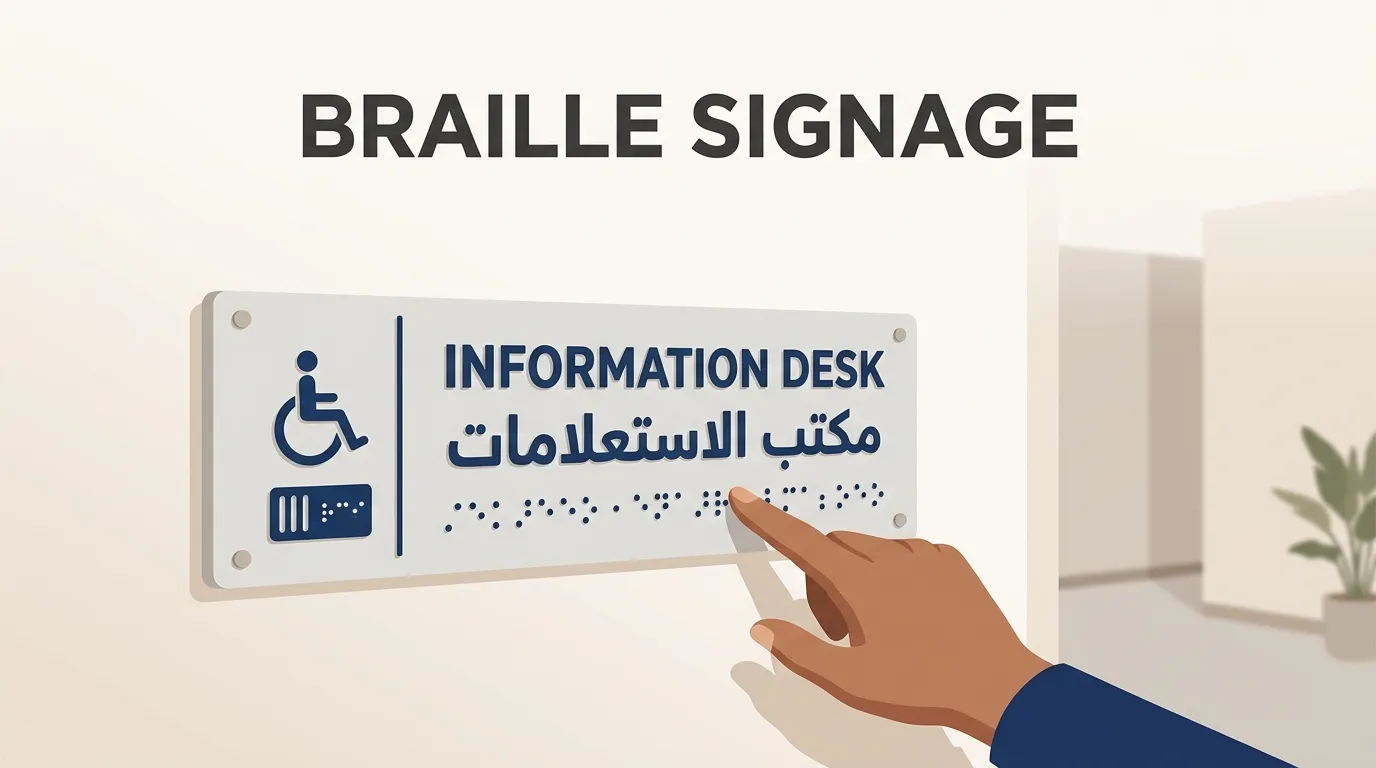
What Is Braille Signage?
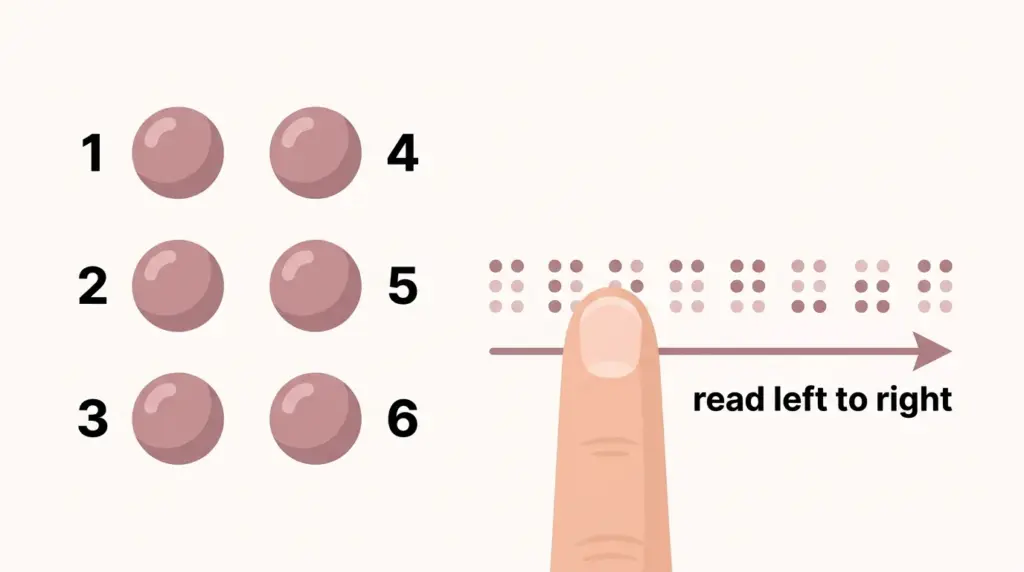
Braille is a tactile writing system made of raised dots arranged in cells. Each cell holds up to six dots in two columns of three, and different combinations of dots represent letters, numbers, and punctuation. A person reads by running their fingertips across the dots, decoding the pattern in the same way a sighted reader decodes printed letters.
These signs put this system onto room and facility plates so a visually impaired person can read a door sign, a lift button panel, or a floor number independently.
It is important to separate two terms that are often used together but mean different things:
- Tactile signage uses raised characters, letters, numbers, and symbols that can be felt and read by anyone through touch. The letters are the same shape as printed text, just raised from the surface.
- Braille signage uses the dot system, which requires fluency in Braille to decode.
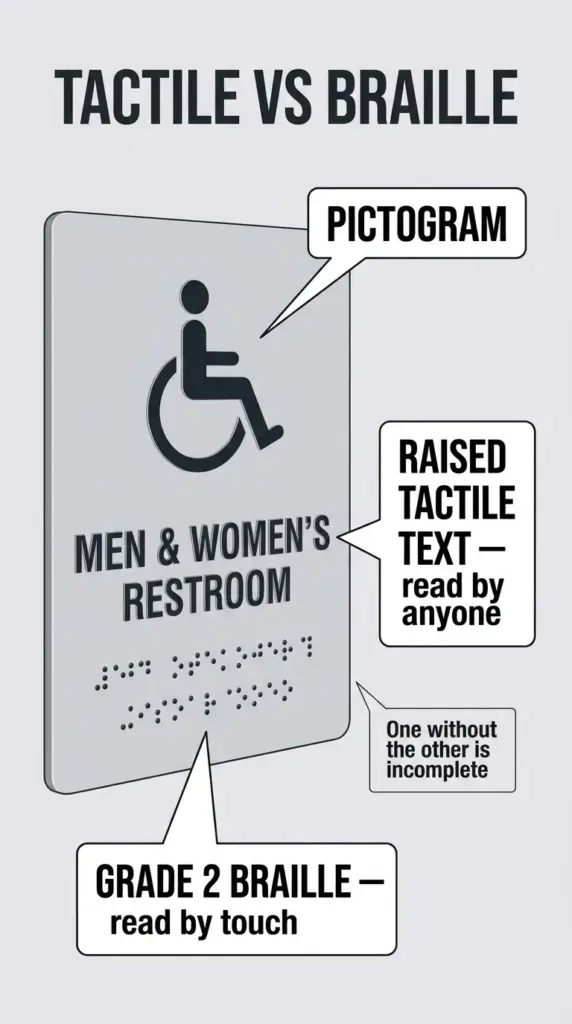
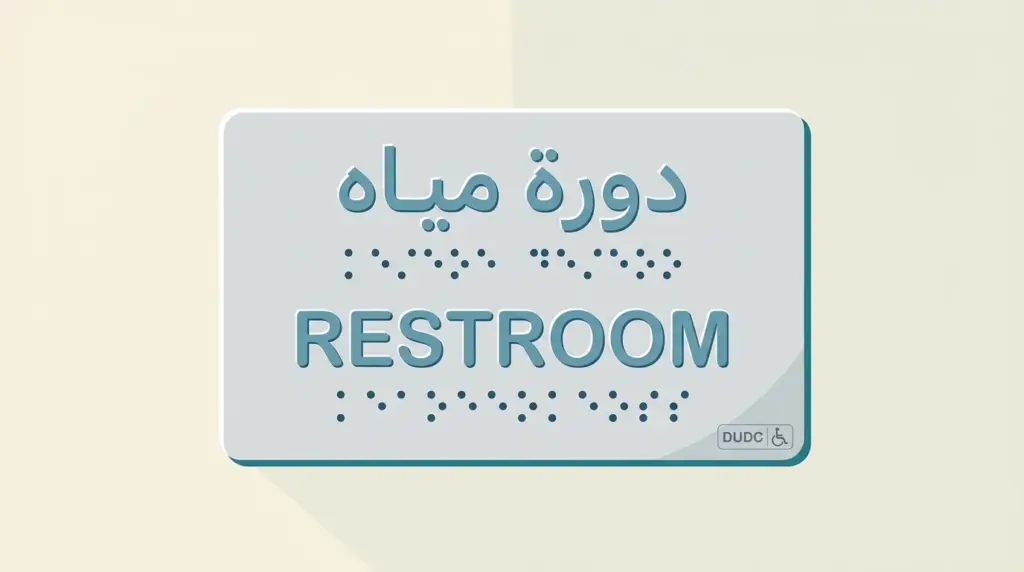
A compliant accessible sign carries both: raised tactile text for broader reach, and Braille dots below it for fluent Braille readers. One without the other is incomplete.
How It Works
The dot system
Each Braille character occupies a cell of up to six dots. The pattern within the cell identifies the character. A reader moves their fingertips along a line of cells from left to right, feeling each pattern in sequence, the same direction as visual reading.
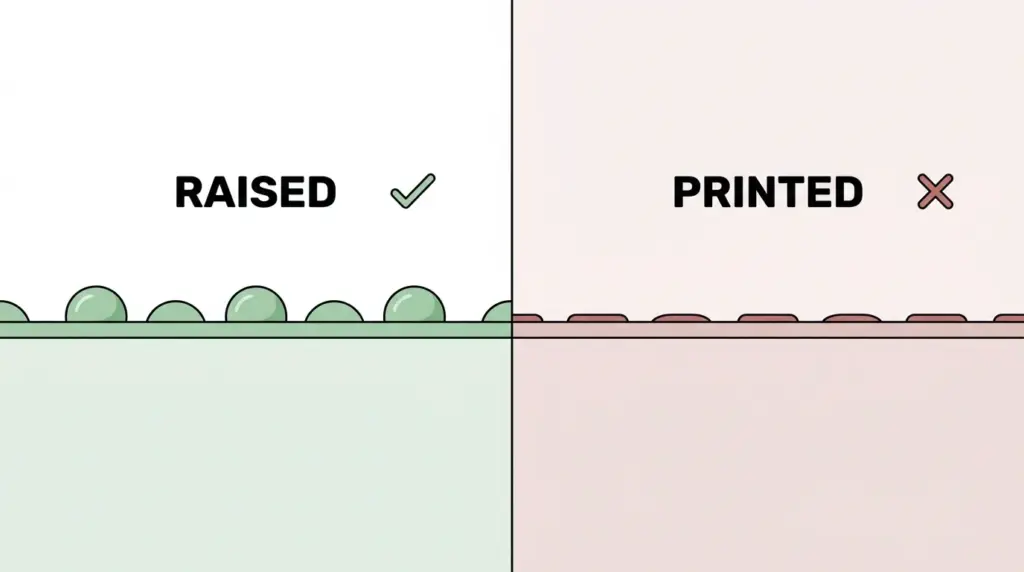
The dots must be physically raised from the surface, domed and rounded at the tip, not flat or pointed. A flat dot is hard to feel accurately, and a sharp dot is uncomfortable. This physical requirement is why Braille must be manufactured into the sign, not printed onto it.
Grade 2 Braille
Signage uses Grade 2 Braille, also called contracted Braille. Grade 2 uses shorthand contractions so that common words and letter combinations are represented by a single symbol rather than spelled out in full. This saves space on a sign and speeds up reading. Grade 1 Braille, which spells every word out in full, is used for learning, not for building signage.
Where the Braille sits on the sign
Braille is placed directly below the corresponding raised tactile text or pictogram on the same plate. The dots are separated from the tactile characters by a small gap so a reader’s fingers move cleanly from the text to the Braille below without confusion. Multi-line text has its Braille grouped below the full block, not under each line individually.
Manufactured, not printed
This is the point that causes the most rework on UAE projects. Braille on a sign must be a physical, raised feature produced during manufacturing, either through injection moulding, CNC machining, photopolymer resin, raster beads embedded in the substrate, or stamped metal. A dot that is printed or drawn onto a flat surface is not readable by touch and fails both accessibility and compliance. Any sign claiming Braille compliance whose dots have no physical height is not a Braille sign.
The Purpose of Accessible Tactile Signs
Accessible tactile signs serve one primary purpose: allowing people with visual impairments to move through a building independently, without needing to ask for assistance at every door. That independence matters for dignity as much as it does for practicality.
Beyond the individual benefit, it serves a few clear institutional purposes:
- Legal compliance. In Dubai, the Dubai Universal Design Code requires Braille and tactile signage in many buildings. A building without it can fail inspection, delay handover, and carry the cost of retrofitting signs, which is always more expensive than building them in from the start.
- Wosool certification. Wosool is the UAE’s accessibility certification scheme. It is assessed against the Dubai Universal Design Code, and a building pursuing this certification must include properly produced bilingual tactile and Braille plates. Many projects and building handovers require it.
- Inclusive design. A building with clear tactile and Braille signs signals that every visitor is considered, which matters to healthcare facilities, government buildings, hotels, and any organisation that serves the public.
Types of Tactile and Braille Signs
Braille and tactile signs appear wherever a building has permanent rooms, facilities, or routes that need identification:
- Room and office signs. The most common type: a nameplate or number on a door identifying an office, meeting room, or department.
- Restroom signs. Standard on male, female, accessible, and gender-neutral restroom doors.
- Lift and elevator signs. Floor indicators inside the lift, and identification panels on each landing showing the floor level.
- Staircase signs. Floor numbers at stair landings and tactile markers at the top and bottom of stairs, where a person needs to know their level without seeing a number.
- Exit and emergency signs. Tactile and Braille markers on emergency exit doors and along evacuation routes.
- Accessible facility signs. Markers identifying prayer rooms, nursing rooms, baby-change facilities, and other building amenities.
- Directional and wayfinding plates. Braille on directional panels in large buildings, helping a visually impaired person orient themselves at a junction.
Braille Signage Examples in the UAE
These are the settings where tactile and Braille signs are most commonly required and inspected in Dubai and the wider UAE:
Hospitals and clinics need Braille on every patient room, department, lift, restroom, and exit. A visitor or patient who cannot see must be able to move from the entrance to a ward independently, which requires a complete, consistent system of tactile and Braille signs throughout.
Offices and corporate towers in areas like Business Bay, DIFC, and JLT mark meeting rooms, floor levels, restrooms, and emergency exits. A large tower serving hundreds of tenants and thousands of daily visitors is expected to make every permanent room independently navigable.
Hotels require Braille on guest room doors, lift panels, emergency exit routes, and facility signs. With Dubai’s visitor numbers, an international guest who is visually impaired must be able to find their room and move around the floor without staff assistance at every step.
Government buildings and public facilities carry some of the strongest compliance expectations, since they serve everyone and are subject to inspection before opening.
Shopping malls need Braille on restroom signs, accessible parking markers, and any permanent facility that a visitor with a visual impairment would need to find.
Residential towers require tactile and Braille signs on apartment doors, lift panels, floor landings, and emergency exits as standard in accessible buildings.
Braille Signage Requirements in the UAE
This is where the UAE differs sharply from most other markets, and where the most common and expensive mistakes happen.
The binding standard is the Dubai Universal Design Code, not ADA
The American Disabilities Act is US legislation. It is not the law in Dubai. A project assessed by the Dubai Municipality or another authority is assessed against the Dubai Universal Design Code (DUDC), and the two standards differ in important ways.
Both agree on the fundamentals: physical raised characters, Braille on the same plate, rounded dome-shaped dots, a non-glare finish, good contrast, and mounting within a reach band that a seated wheelchair user and a standing reader can both access. The detail of those measurements, however, is set in the DUDC in metric units, and a direct inch-to-millimetre conversion of ADA figures does not satisfy the code.
The single most common cause of failed accessibility inspections in Dubai is a drawing that says “ADA compliant” instead of naming the DUDC and its current revision. Fix this with one line: name the governing document on the drawing.
Arabic Braille is required
No American standard addresses Arabic. This is the requirement that has no equivalent elsewhere and catches international consultants most often.
In the UAE, accessible signage must be bilingual in Arabic and English, and that bilingual requirement extends to Braille. A sign needs Arabic Braille alongside English Braille. English Grade 2 Braille alone does not satisfy the requirement. Arabic Braille follows the Unified Arabic Braille system and must be produced with the same physical dot standards as the English Braille on the same plate.
This matters for more than compliance. A large share of the UAE population reads Arabic as a first language, and a Braille sign that only serves English readers is not fully accessible in this market.
Wosool certification
Wosool is the UAE’s official accessibility certification. It is assessed entirely against the Dubai Universal Design Code, not ADA, and many building handovers require it. A project pursuing Wosool must demonstrate bilingual, physically raised, DUDC-compliant accessible signage as part of the audit.
A note on dimensions
The DUDC sets specific requirements for raised character height, Braille dot shape, mounting height, and contrast. Because these figures are revised over time and can differ between authorities and project types, we do not publish them here. Always take the current dimension from the DUDC directly, confirm it with the relevant authority for your project, and state the datum clearly on your drawing before manufacturing begins. A sign manufactured to an old figure is a sign that may need remaking.
Materials and Manufacture
The right material depends on where the sign goes and how it is produced:
- Acrylic is the most common indoor material. It is produced in a range of finishes and colours, accepts raster Braille beads or machined dots cleanly, and gives a crisp non-glare surface with good contrast.
- Photopolymer resin is a durable plastic used for precise, moulded Braille plates with consistent dot geometry.
- Aluminium and stainless steel are used for premium or high-traffic signs. CNC-stamped Braille into stainless is common for lift panels and signs in environments that are cleaned frequently or face heavy use.
- Composite substrates combine layers for durability and a branded colour finish while keeping the sign light.
Indoors, material choice is led by brand match, durability, and finish. Outdoors, a weather and UV-rated material is needed so the dots stay legible and the surface does not warp or fade.
Working With Bab Al Mashriq
Bab Al Mashriq produces Braille and tactile signage for buildings across Dubai and the wider UAE, manufactured in-house with physical raised characters and Braille dots to DUDC requirements, in both Arabic and English. The work covers room signs, restroom plates, lift and floor signs, exit and emergency signs, and complete building accessibility packages, in acrylic, aluminium, and stainless steel depending on the project.
Because the signs are fabricated in-house rather than outsourced, the dot geometry, contrast, and finish are controlled from the start and the bilingual requirement is built in, not added as an afterthought. To discuss an accessibility signage project, call +971 52 97 92 557 for a quote.
Frequently Asked Questions
Is Braille signage mandatory in the UAE?
Yes, in many buildings. The Dubai Universal Design Code requires Braille and tactile signage in buildings open to the public, and inspections check for it before handover. It is also a requirement for Wosool accessibility certification. Treating it as optional is the reason many projects face costly retrofits late in construction.
Does Braille signage in Dubai need to include Arabic?
Yes. UAE accessibility signage must be bilingual, and that extends to Braille. A sign needs Arabic Braille alongside English Braille on the same plate. English-only Braille does not meet the requirement, and no American standard addresses Arabic, which is why ADA specification alone falls short in this market.
What is the difference between tactile and Braille signage?
Tactile signage uses raised letters, numbers, and symbols that anyone can read by touch. Braille uses a system of raised dots that requires fluency to decode. A compliant accessible sign carries both on the same plate: tactile characters above and Braille dots below.
Why does my consultant keep writing “ADA compliant” on drawings?
ADA is the American standard and is commonly used as a shorthand for accessible signage. It is not the law in Dubai. A Dubai project is assessed against the Dubai Universal Design Code, which uses metric dimensions, requires Arabic, and specifies regional Braille. Replace “ADA compliant” with the DUDC and its current revision on every drawing. This single change prevents the most common inspection failures.
What is Grade 2 Braille and why is it used on signs?
Grade 2, or contracted Braille, uses shorthand symbols for common words and letter combinations, which saves space on a sign and speeds up reading. Grade 1 Braille spells every word in full and is used for learning, not building signage. Standard accessibility codes require Grade 2 on identification signs.
What materials are Braille signs made from?
Common materials are acrylic for most indoor signs, photopolymer resin for precise moulded plates, and aluminium or stainless steel for high-traffic or frequently cleaned areas like lifts. The Braille dots must be physically raised through manufacturing, not printed, regardless of the substrate.
Where exactly does Braille go on a sign?
Braille sits directly below the raised tactile text or pictogram on the same plate, separated from the characters by a small gap. For signs with multiple lines, the Braille is grouped below the full text block rather than placed under each line individually.
- Braille signage uses raised dot patterns read by touch, allowing visually impaired people to navigate a building independently.
- A compliant sign carries both raised tactile characters and Braille dots on the same plate. One without the other is incomplete.
- Braille must be physically manufactured into the sign with raised domed dots, not printed onto a flat surface.
- Grade 2 contracted Braille is the standard for building signage.
- In the UAE, the binding standard is the Dubai Universal Design Code, not ADA. The two differ in measurement system, and the DUDC requires Arabic in a way ADA does not.
- UAE Braille signage must include Arabic Braille alongside English Braille. English-only Braille fails the requirement.
- Wosool certification relies entirely on DUDC compliance, and many UAE building handovers require it.
- Writing “ADA compliant” instead of naming the DUDC is the single most common cause of accessibility inspection failures in Dubai.