
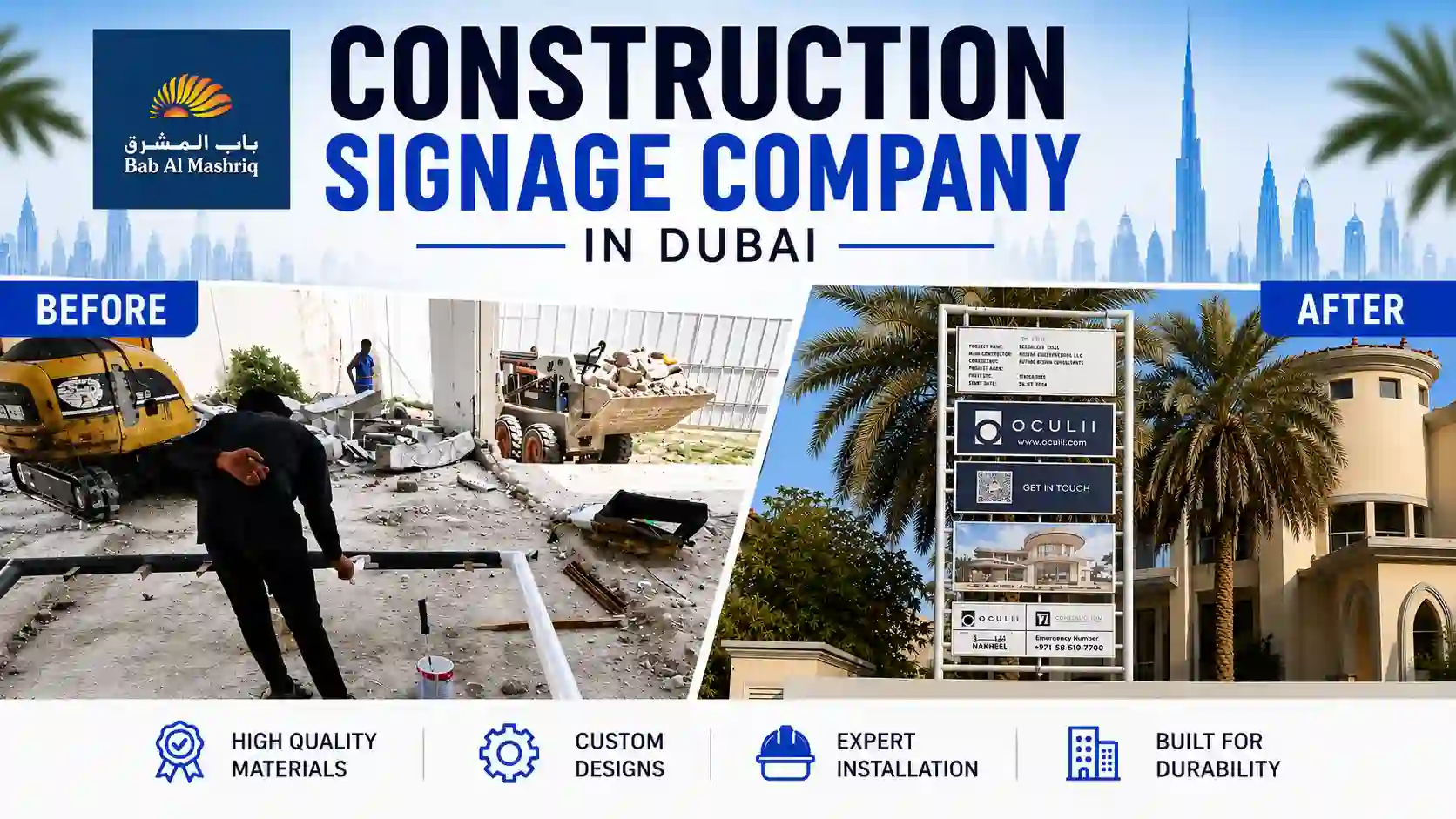
Bab Al Mashriq designed, fabricated, and installed a 2m by 6m free-standing construction signboard for developer OCULII at Villa 99, Frond E, on Palm Jumeirah. The steel-framed, GI-sheet structure was built in-house, delivered to site, and erected on concrete footings within a 10-working-day program, backed by a 1-year warranty.
| Client | OCULII |
| Site engineer | Mr. Sanket Gupta |
| Location | Villa 99, Frond E, The Palm Jumeirah, Dubai |
| Board size | approx. 2000mm (W) x 6000mm (H) |
| Delivery time | 10 working days |
| Warranty | 1 year |
| Payment terms | 60% advance, 40% on completion |
| Bab Al Mashriq project lead | Muhammad Arshad |
Project background
OCULII was developing Villa 99 on Frond E and needed a construction signboard to mark the plot. The board had to carry the developer’s branding, a QR “Get in Touch” panel, an architectural render of the finished villa, and the project’s Modification Works NOC details, since Palm Jumeirah plots require that information to be posted on site during construction.
Bab Al Mashriq worked directly with site engineer Mr. Sanket Gupta on the drawing, the fabrication schedule, and the installation date, coordinating around an active construction site that already had excavation and demolition crews working nearby.
The challenge: a 6-metre sign on a live, regulated beachfront plot
A board this size is not a simple print-and-post job. Three problems had to be solved before anyone could touch a welding torch.
Wind load. At six metres tall, the board behaves like a sail. Palm Jumeirah sits fully exposed to open sea wind, so the frame, the posts, and the foundation all needed enough mass and rigidity to stay upright through gusts that a smaller inland sign would never face.
Regulatory compliance. Palm Jumeirah falls under Trakhees, the DP World-managed authority responsible for signage approvals in JAFZA, Dubai South, and Palm Jumeirah, rather than Dubai Municipality or DDA. Separately, any sign fixed above 2.5 metres requires a structural review and a risk assessment before installation, under the same rules Bab Al Mashriq documents on its own signage approval guide. At six metres, this board was well past that threshold. The completed board also carries the Nakheel logo alongside its NOC reference number, confirming it meets Nakheel’s community requirements for construction signage inside a Nakheel-managed plot. The NOC reference itself is prefixed “TRS,” consistent with a Trakhees-processed approval.
Site access and sequencing. Frond E was an active build. Materials and crew had to move around a skid steer loader, an excavator, and other trades already clearing debris on site, without blocking the plot’s single access road.
The Bab Al Mashriq solution
The team designed the signboard as a free-standing steel structure with a printed façade, fabricated at Bab Al Mashriq’s own facility and finished on site.
Structural frame. GI/MS pipe posts, 5cm in diameter with 2mm wall thickness, were cut, mitred, and welded into a supporting frame with clamped side elbow joints, matching the approved drawing. The frame was assembled flat before being stood upright.
Board face. The face panel used 0.5mm GI sheet, with 3mm ACP offered as an alternative material. This gives a rigid, warp-resistant base for the printed graphics: the OCULII logo, the NOC panel, the QR code, and a full-colour render of the villa with the address “Villa 99, Frond E, Palm Jumeirah, Dubai, UAE” printed along the bottom edge.
Base and foundation. Bab Al Mashriq supplied 8mm base plates with anchor bolts ahead of installation. Precast concrete blocks were delivered to site to serve as footings for the posts. The client’s civil team cast the final concrete anchoring around those plates, a scope split that kept both sides of the work moving without waiting on each other.
Finish. All exposed steel received a weather-resistant black-and-white paint finish, matched to the OCULII brand colours and built to resist UV exposure and salt air on a beachfront plot.
From fabrication to handover
1. Frame fabrication. Two fabricators welded the post-and-frame skeleton at the site, working the elbow joints to the drawing’s exact angles with the Dubai skyline visible across the water.
2. Base preparation. Precast concrete blocks arrived by flatbed ahead of the frame, so footing points were ready the moment the posts were ready to stand.
3. Delivery to site. Frame sections, rolled print material, and fittings travelled to Frond E on a flatbed cargo truck.
4. Panel printing and edging. The architectural render panel, printed on rigid board with aluminium edge trims, was produced separately and fitted to the frame along with the developer branding and NOC panels above it.
5. Erection. With the footings ready, the frame was raised into position. A mobile crane held the six-metre structure steady while the crew secured it to the anchor bolts, then the black infill panels and printed faces went on section by section.
6. Handover. The finished board was checked for level, plumb, and panel alignment, with the QR panel and NOC details placed at eye level for anyone walking or driving past the plot.
Project specifications
| Item | Specification |
|---|---|
| Overall size | Approx. 2000mm (W) x 6000mm (H) |
| Board material | 0.5mm GI sheet (3mm ACP optional) |
| Support posts | GI round pipe, 5cm diameter, 2mm wall thickness |
| Frame | GI/MS supporting frame, clamped side elbow joints, per approved drawing |
| Base plates | 8mm steel with anchor bolts |
| Foundation | Cast by client’s civil contractor |
| Finish | Weather-resistant black/white paint |
| Delivery | Included, direct to site |
| Installation | Full fabrication and on-site installation by Bab Al Mashriq |
| Lead time | 10 working days |
| Warranty | 1 year |
| Payment terms | 60% advance, 40% on completion |
The result
OCULII now has a compliant construction signboard standing at Villa 99, Frond E, carrying the Nakheel NOC reference, developer branding, and a full render of the villa, built to hold up through the rest of the construction program on an exposed Palm Jumeirah plot. The 60/40 payment split and the clean handoff on foundation work meant neither side waited on the other to keep moving.
Why developers choose Bab Al Mashriq for construction signage
Anyone hiring a signage contractor for a regulated plot like Palm Jumeirah is really asking one question: will this sign pass inspection and still be standing in a year, or will it come back as a compliance problem. Three things address that directly.
Approvals handled correctly the first time. Bab Al Mashriq tracks which authority governs which zone, Dubai Municipality, DDA, Trakhees, or DMCC, and builds the NOC and structural-review requirements into the drawing before fabrication starts, rather than fixing it after a rejection.
Fabrication stays in-house. The frame welding, panel printing, and paint finishing for this project all happened at Bab Al Mashriq’s own facility, with no subcontracted step between the drawing and the finished board.
Foundation scope is split cleanly. Supplying the base plates and anchor bolts while leaving the concrete casting to the client’s civil contractor, as happened on this project, avoids the common delay where a signage contractor and a civil contractor both wait on each other.
See more construction signage projects or get a quote for your site.
Frequently asked questions
Which authority approves construction signage on Palm Jumeirah?
Trakhees, the DP World-managed authority, handles signage and advertising approvals for Palm Jumeirah, JAFZA, and Dubai South. This is different from Dubai Municipality or DDA, which cover mainland and TECOM free zone businesses.
Does a tall construction signboard need structural approval?
Yes. Any sign fixed above 2.5 metres requires a structural review and a risk assessment before installation. A 6-metre board like this one is well above that threshold, so the frame, base plates, and foundation all need to be engineered for wind load, not just for looks.
Who supplies the foundation for a free-standing signboard?
Bab Al Mashriq supplies the base plates and anchor bolts. The client’s civil contractor typically casts the concrete foundation on site, which is how the base work was split on this project.
How long does construction signage fabrication and installation take in Dubai?
Minimum lead time is 10 working days from drawing approval, covering fabrication, delivery, and installation, assuming the site is ready to receive the footings.
What materials hold up best for outdoor construction signage in Dubai’s climate?
GI sheet at 0.5mm thickness or 3mm ACP for the board face, GI/MS pipe for the frame, and a weather-resistant paint finish are standard for boards that need to survive UV exposure, heat, and, on beachfront plots, salt air.