
Indoor signs are interior signs that brand a space, guide people through it, and share information inside a building. Common types include reception and lobby signs, wayfinding and directional signs, door and room signs, directory boards, wall graphics, and safety signs. They work through mounting method, finish, and close-up legibility, and because people see them up close, finish and brand match matter more than weather resistance. In Dubai, accessibility signs must also carry Arabic and Braille.
Indoor signs are signs placed inside a building to identify areas, guide movement, share information, and carry a brand through a space. You meet them the moment you walk into a lobby, follow a directional arrow down a corridor, or read a meeting-room nameplate. Unlike exterior signs, which fight the weather, interior signs are judged up close, so finish, legibility, and brand match matter most.
What Are Indoor Signs?
An indoor sign is any sign made for the interior of a building. Because it lives in a sheltered, stable space, it does not need heavy weatherproofing, which frees up a wider range of materials and finishes.
That shift in priorities is the key difference from outdoor signage. An outdoor sign is engineered first to survive sun, heat, and rain. An indoor sign is designed first to look right and read clearly at close range, since people often stand within a metre or two of it. Finish quality, colour match to the brand, and clean mounting all show at that distance, so they carry more weight indoors than raw durability does.
How Indoor Signs Work
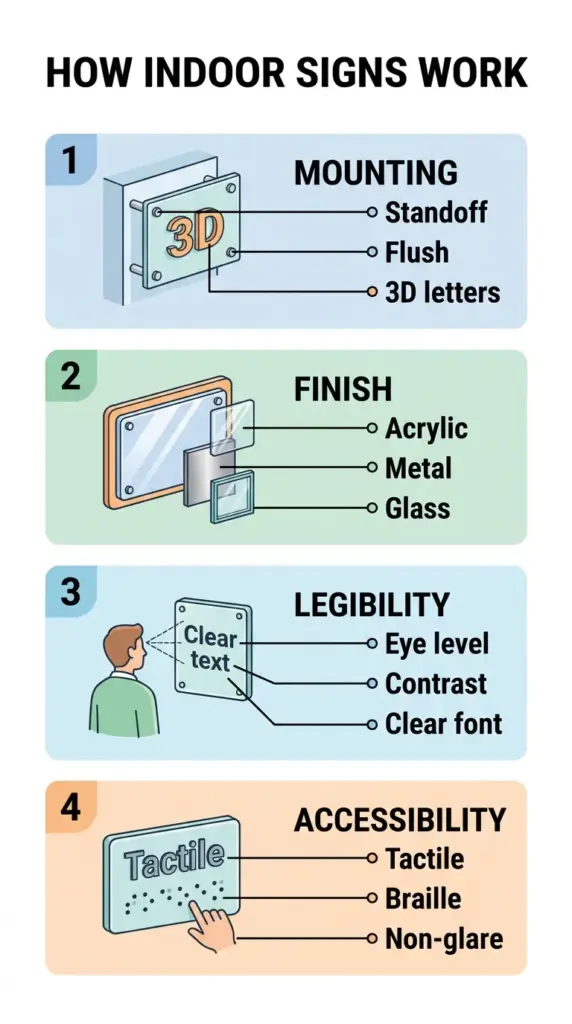
Three things decide whether an interior sign does its job well: how it is mounted, how it is finished, and how easily it reads up close.
Mounting: how the sign attaches and stands out
Mounting method changes both the look and the feel of a sign, and it is where much of the craft sits indoors:
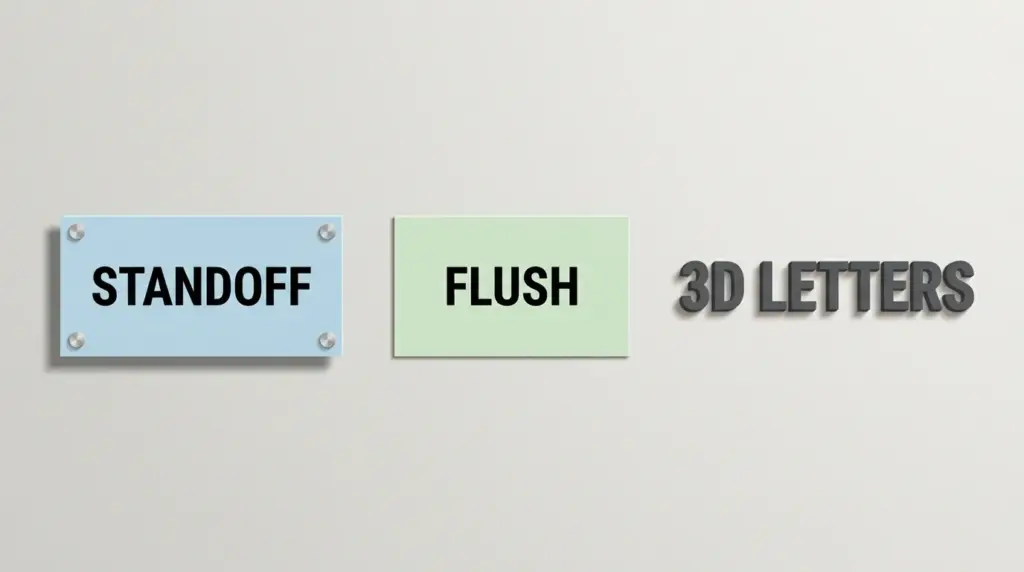
- Standoff mounting. The sign sits slightly off the wall on polished metal barrels, casting a subtle shadow. This is the premium look for reception and lobby signs.
- Flush mounting. The sign is fixed flat to the wall for a clean, simple finish, common for directories and notices.
- Dimensional (3D) lettering. Individual raised letters or a logo are mounted directly on the wall, giving depth and a high-end feel behind a front desk.
- Vinyl and decals. Printed or cut vinyl applied straight onto walls, glass, or doors, ideal for graphics, frosted-glass privacy, and quick branding.
Finish and materials: how the sign looks up close
Indoors, the finish is the product. A brushed stainless letter, a bevelled acrylic edge, or a frosted glass panel reads as quality because the viewer is close enough to see it. The common indoor materials each carry a different feel: acrylic for a clean modern look, brushed or polished metal for premium branding, frosted vinyl on glass for privacy with light, and foam or PVC for light, affordable lettering. The right choice matches the material to the brand and the interior, not to the weather.
Legibility and placement: how the sign gets read
An indoor sign works only if it is seen at the right moment. That means placing it where a decision is made, a junction, a doorway, a lift lobby, and setting it at eye level with clear contrast between text and background. Simple, consistent fonts and symbols let people read a sign at a glance as they move, which is the whole point of wayfinding inside a busy building.
Accessibility: how the sign serves everyone
Many interior signs, especially room and facility signs, need to be readable by touch as well as sight. That means raised tactile characters and Braille on the same plate, good contrast, and a non-glare finish, mounted within reach. In Dubai this is not optional for many buildings, and it carries a local requirement covered below.
Common Types of Indoor Signs
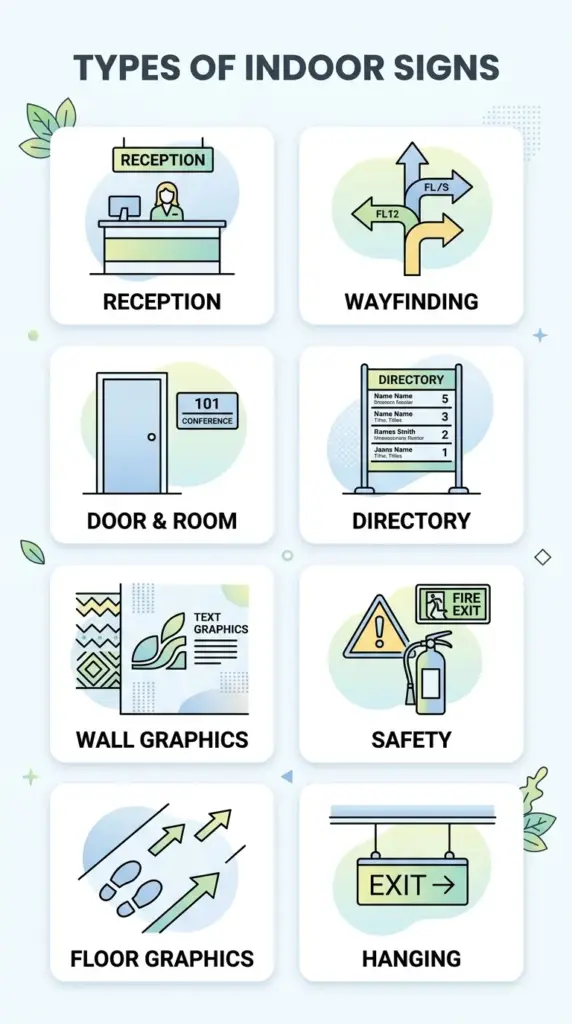
Interior signs come in several forms, each with a clear job:
- Reception and lobby signs: The branded logo behind a front desk, usually the first thing a visitor sees.
- Wayfinding and directional signs: Arrows and markers that guide people through corridors and floors.
- Door and room signs: Nameplates and numbers that identify offices, meeting rooms, and facilities.
- Directory boards: Lists of tenants or departments near an entrance or lift lobby.
- Wall graphics and murals: Printed or cut vinyl that brands and decorates walls.
- Safety and regulatory signs: Fire exits, first aid, and rule signs required inside occupied buildings.
- Floor graphics: Walk-on decals that direct traffic or mark zones.
- Hanging signs: Ceiling-hung signs that mark departments or aisles, useful in large stores.
For a fuller breakdown of every sign format, see our guide on the different types of signs.
What Interior Signs Are Used For
Businesses use interior signs for several clear reasons:
- First impressions. A branded reception sign sets the tone the moment a client walks in.
- Wayfinding. Directional and room signs get visitors to the right place without asking staff, which matters most in large offices, hospitals, and malls.
- Branding. Consistent logos, colours, and wall graphics carry a brand through every room a customer passes.
- Information. Directories, notices, and instruction signs answer common questions on the spot.
- Safety and compliance. Fire exit, first aid, and accessibility signs are required by law and keep a building inspection-ready.
Most spaces use a mix: a lobby sign to brand the entrance, wayfinding to move people, and room signs to help them arrive.
Choosing Interior Signs: Materials and Finish
Indoors, the material choice is led by look rather than weather. The usual options are:
- Acrylic: Clean, modern, and available in many colours and finishes. A popular choice for lobby and reception signs.
- Brushed or polished metal: Stainless steel or aluminium for a premium, corporate feel, often as dimensional letters.
- Frosted and printed vinyl: Applied to glass for privacy, branding, or graphics without blocking light.
- Foam and PVC: Light and affordable for lettering, temporary notices, and budget projects.
- Glass: Etched or frosted panels for an upmarket reception or boardroom look.
The deciding factor is how the sign matches the brand and the interior, and how well the finish holds up to close viewing and regular cleaning.
Indoor Signage and Accessibility in Dubai
Accessibility is where indoor signage in Dubai has a firm local rule. Many buildings must provide tactile and Braille signage on rooms and facilities, and the binding standard is the Dubai Universal Design Code, not the American ADA.
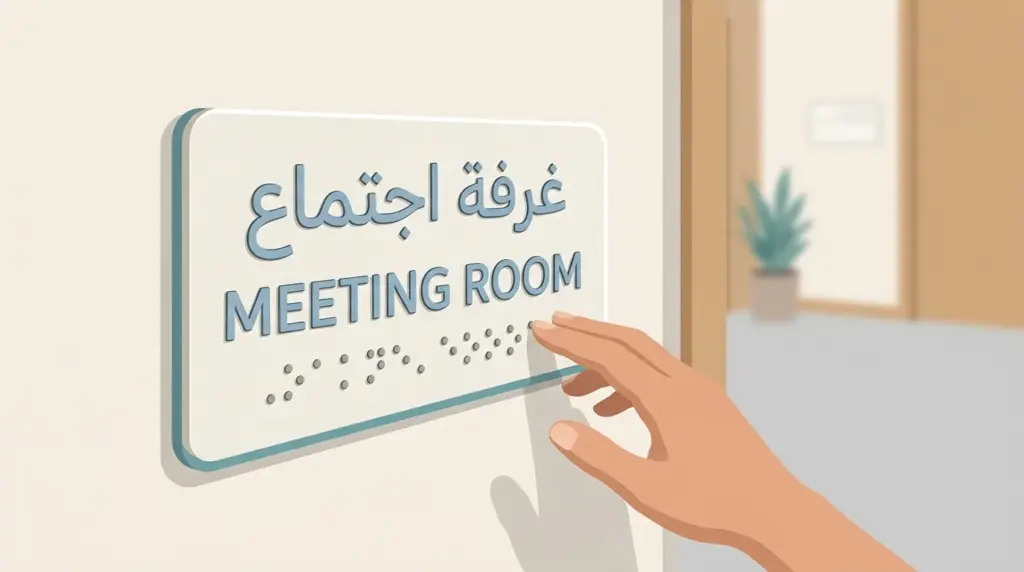
The important local difference is language. Accessible signs in Dubai must carry Arabic as well as English, including Arabic Braille alongside raised tactile characters on the same plate. An ADA-style, English-only plate does not meet the requirement. Getting this right is often part of building handover, so it is worth planning into an interior signage project from the start rather than fixing later.
Working With Bab Al Mashriq
Bab Al Mashriq designs, manufactures, and installs indoor signage across Dubai and the wider UAE, from reception and lobby signs to wayfinding, room signs, directories, wall graphics, and tactile accessibility signage. Fabrication is in-house across every physical material an interior project needs, from acrylic and brushed metal to frosted glass and vinyl, finished to match the brand and the space.
Because design and manufacturing happen under one roof, an interior signage set is planned as a whole and built to meet local accessibility requirements, then installed as a finished system. To discuss an indoor signage project, call +971 52 97 92 557 for a quote.
Frequently Asked Questions
What is considered an indoor sign?
An indoor sign is any sign made for the interior of a building, such as a reception logo sign, a directional sign, a door or room nameplate, a directory board, a wall graphic, or an interior safety sign. What sets it apart from an outdoor sign is that it is designed for close-up viewing and brand match rather than weather resistance.
What is the difference between indoor and outdoor signs?
Outdoor signs are engineered first to survive sun, heat, rain, and wind, and to be read from a distance. Indoor signs are designed first to look right and read clearly up close, so finish, brand match, and clean mounting matter more than durability. The materials and mounting methods differ as a result.
What are the most common indoor signs for an office?
The core office signs are a reception or lobby sign behind the front desk, directional and wayfinding signs in corridors, door and meeting-room nameplates, a directory board near the entrance, and required safety signs like fire exits. Many offices add wall graphics to carry the brand through the space.
What materials are used for indoor signs?
Common indoor materials are acrylic for a clean modern look, brushed or polished metal for a premium feel, frosted or printed vinyl on glass, and foam or PVC for light, affordable lettering. Indoors the choice is led by finish and brand match rather than weather resistance.
Do indoor signs in Dubai need Braille or Arabic?
Many do. Accessible room and facility signs in Dubai must carry raised tactile characters and Braille, and under the Dubai Universal Design Code they must include Arabic as well as English, with Arabic Braille. An English-only, ADA-style plate does not meet the local requirement.
How are lobby and reception signs mounted?
Premium reception signs are usually standoff mounted, sitting slightly off the wall on polished metal barrels to cast a soft shadow, or made as dimensional 3D letters fixed to the wall. Simpler signs are flush mounted flat to the surface. The mounting method is a big part of how upmarket the sign looks.
- Indoor signs are interior signs that brand a space, guide people through it, and share information.
- They work through mounting method, finish, and close-up legibility, since people view them up close.
- Indoors, finish and brand match matter more than weather resistance, which is the opposite priority to outdoor signs.
- Common types include reception, wayfinding, door and room, directory, wall graphic, and safety signs.
- Common materials are acrylic, brushed metal, frosted vinyl, foam or PVC, and glass, chosen to match the brand.
- In Dubai, accessible indoor signs must carry Arabic and Braille under the Dubai Universal Design Code.