
Outdoor signs are exterior signs that identify, advertise, or guide people to a business from the street. Common types include channel letters, pylon and monument signs, blade signs, lightboxes, banners, and window graphics. They work through a mix of size, lighting, and durable materials so they stay visible day and night. In Dubai, most outdoor signs need a Dubai Municipality permit, must include Arabic, and need heat and UV resistant materials to survive the climate.
Outdoor signs are any signs placed outside a building to identify a business, advertise it, or guide people to it. They range from the lit letters above a shopfront to a tall pylon by the road. Their job is to be seen and understood quickly, often from a moving car or a busy pavement, and in Dubai they also have to meet permit rules and survive extreme heat and sun.
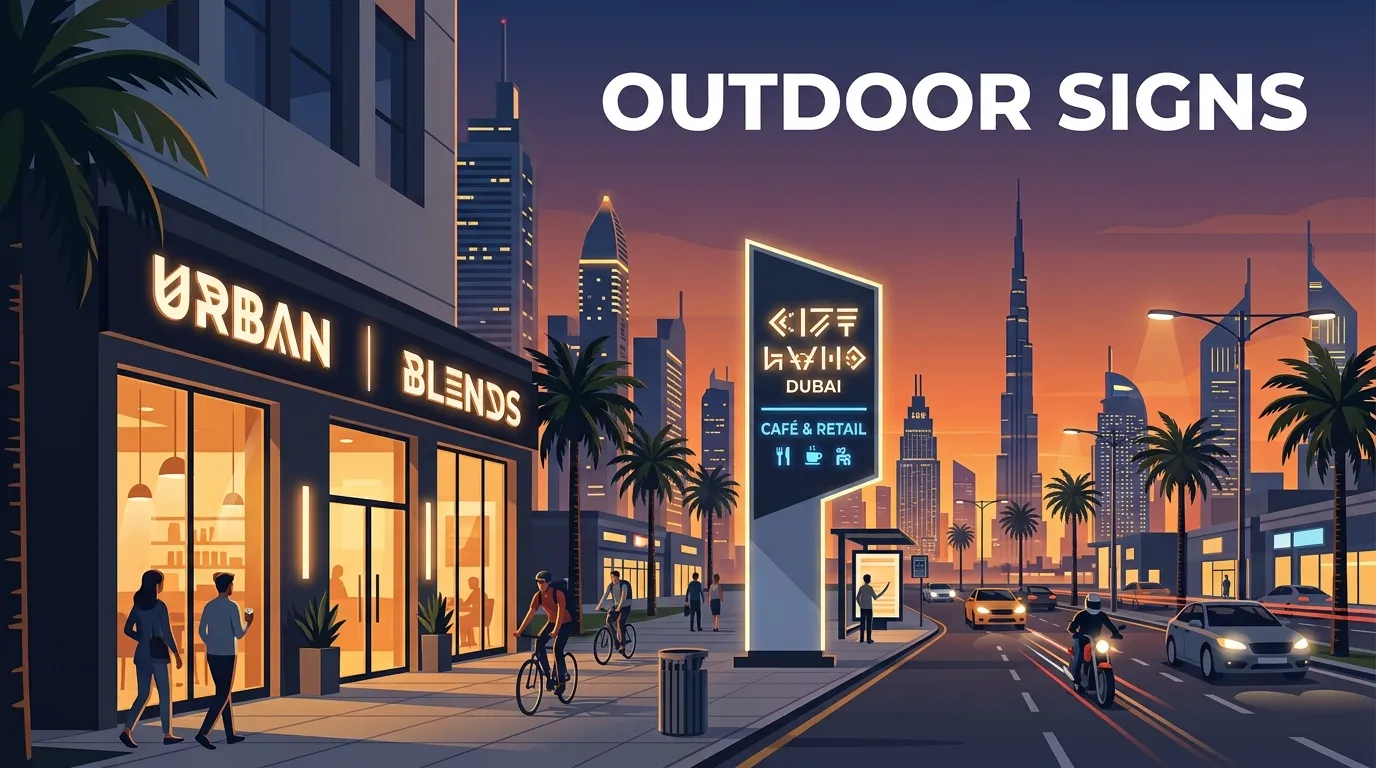
What Are Outdoor Signs?
An outdoor sign is any sign built for the exterior of a building or site. Unlike indoor signs, which live in a stable, sheltered space, exterior signs face sun, heat, rain, wind, and dust, so they are engineered differently from the ground up.
They do three main jobs. They identify a business, telling passers-by who you are and where you are. They advertise, promoting an offer or a brand to people going past. And they guide, pointing customers toward an entrance, a car park, or a specific unit. A single business often uses several exterior signs at once: a fascia sign to name the shop, a blade sign to catch pavement traffic, and a pylon to be seen from the road.
How Outdoor Signs Work
This is where exterior signs differ most from indoor ones. Three things decide whether an outdoor sign does its job: how it is lit, what it is made of, and how it is built for visibility.
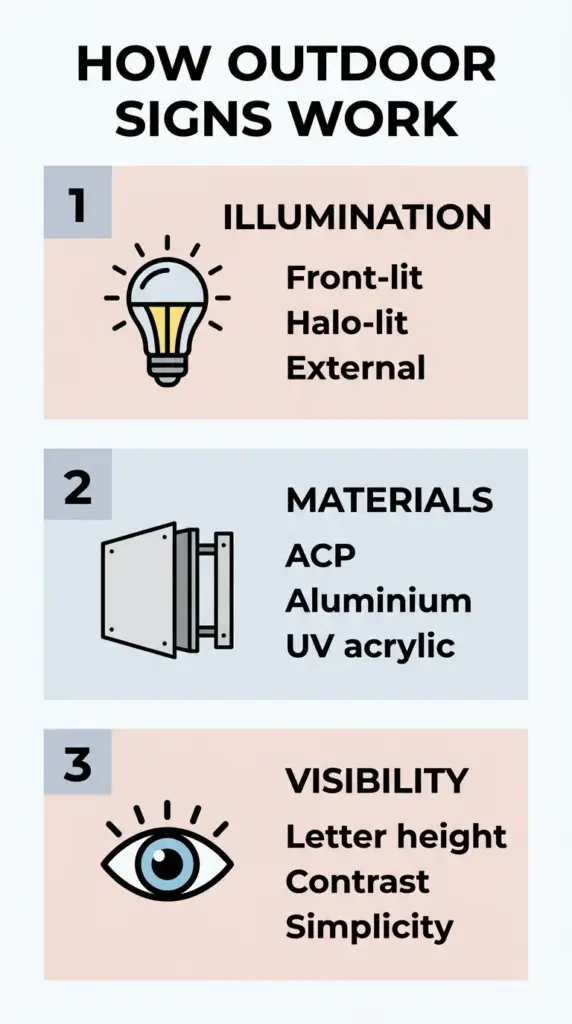
Illumination: staying visible at night
Most effective exterior signs are lit, so they work around the clock. There are two broad approaches:
- Internal illumination. Light sits inside the sign, usually LED. This covers lightbox faces that glow evenly, and channel letters lit from within.
- External illumination. Light shines onto the sign from outside, using spotlights or floodlights aimed at a non-lit face.
Within internally lit signs, the lighting style changes the look:
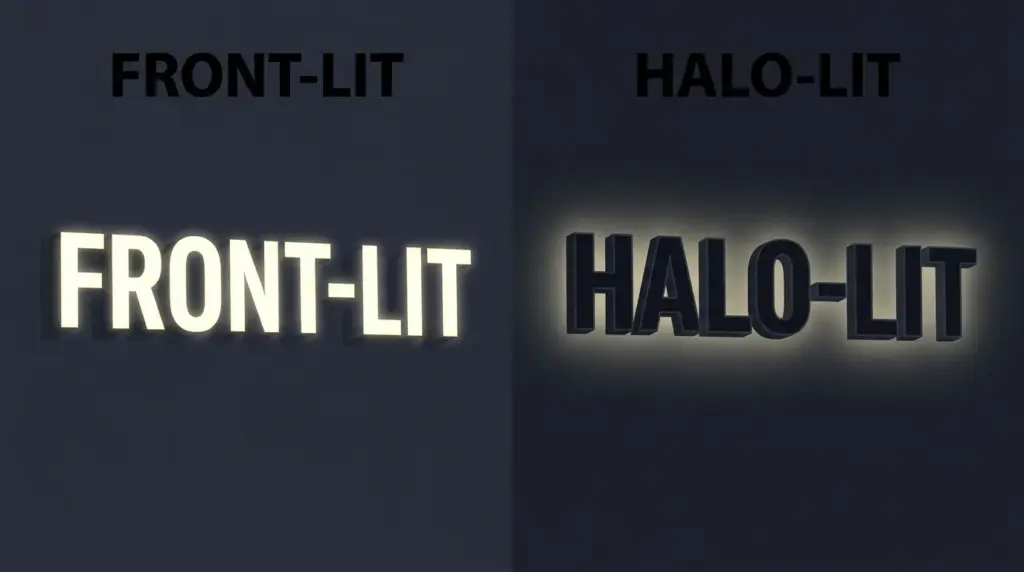
- Front-lit letters glow across the face, the most common and boldest look.
- Halo-lit (back-lit) letters throw light onto the wall behind them, creating a soft glowing outline for a premium feel.
- Backlit lightboxes push light through a printed translucent face for a bright, even panel.
LED has largely replaced older neon and fluorescent lighting because it runs cooler, lasts longer, and uses less power, which matters in the UAE where heat shortens the life of poorly cooled lighting.
Materials: surviving the weather
An outdoor sign is only as good as its weakest material. Outdoors, a sign has to resist UV fade, heat, moisture, and wind. That rules out flimsy indoor materials and favours engineered ones: aluminium composite panel (ACP) for flat faces, aluminium and stainless steel for structure and letters, UV-grade acrylic for lit faces, and cast, UV-rated vinyl for graphics. Cheaper materials look the same on day one and then fade, warp, or peel within a season.
Visibility: getting read in time
A sign that cannot be read in time is wasted. Exterior signs are designed around a few visibility rules:
- Viewing distance and letter height. The further away the viewer, the taller the letters must be. A highway pylon needs much larger text than a shopfront read from the pavement.
- Contrast. High contrast between text and background, like white on dark, reads faster, especially in bright sun or at night.
- Simplicity. A short message in a clear, bold font lands in the seconds a driver or walker has to read it.
Common Types of Exterior Signs
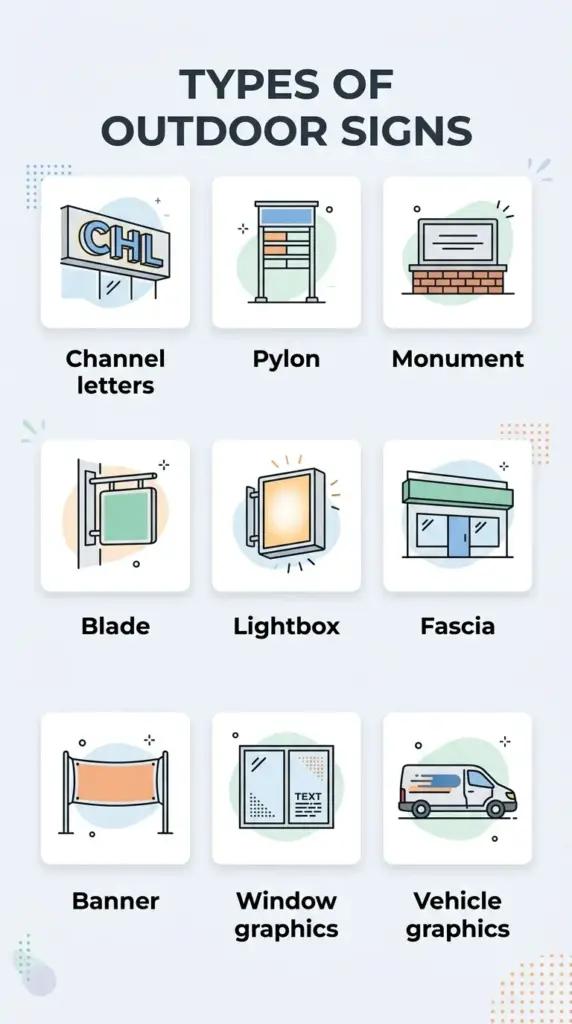
Outdoor signs come in many forms, each suited to a different location and job:
- Channel letters (3D lit letters): Individual illuminated letters on a fascia. Premium look, ideal for retail and restaurants.
- Pylon signs: Tall freestanding signs for roadside visibility, often shared by several tenants.
- Monument signs: Low, solid signs at an entrance that signal permanence, common for offices and communities.
- Blade signs: Projecting signs mounted at a right angle to a wall, made to catch pavement traffic.
- Lightbox and cabinet signs: Illuminated boxes with a printed face, bright day and night.
- Fascia signs: The main sign above a shop entrance, usually the one that needs a permit.
- Banners and flags: Low-cost, short-term signs for events, sales, and openings.
- Window graphics: Printed vinyl on glass for offers and branding, without taking up pavement space.
- Vehicle graphics: Wraps and decals that turn vehicles into moving outdoor ads.
For a fuller breakdown of every sign format, see our guide on the different types of signs.
What Exterior Signs Are Used For
Businesses use exterior signage for several clear reasons:
- Attracting foot traffic. A clear fascia or blade sign pulls in people walking past, and one survey found most consumers have entered a store they had never visited based on its signs alone.
- Roadside visibility. Pylon and pole signs capture drivers from a distance, useful for showrooms, petrol stations, and businesses set back from the road.
- Wayfinding. Directional and identification signs guide customers to an entrance, unit, or car park across a large site.
- Branding. Consistent colours, logos, and lit letters build recognition every time someone passes.
- Promotions. Banners, flags, and window graphics push a short-term offer or event at low cost.
Most businesses use a mix: one sign to grab attention from a distance, another to convert it into a walk-in at street level.
Exterior Signs in the Dubai Climate
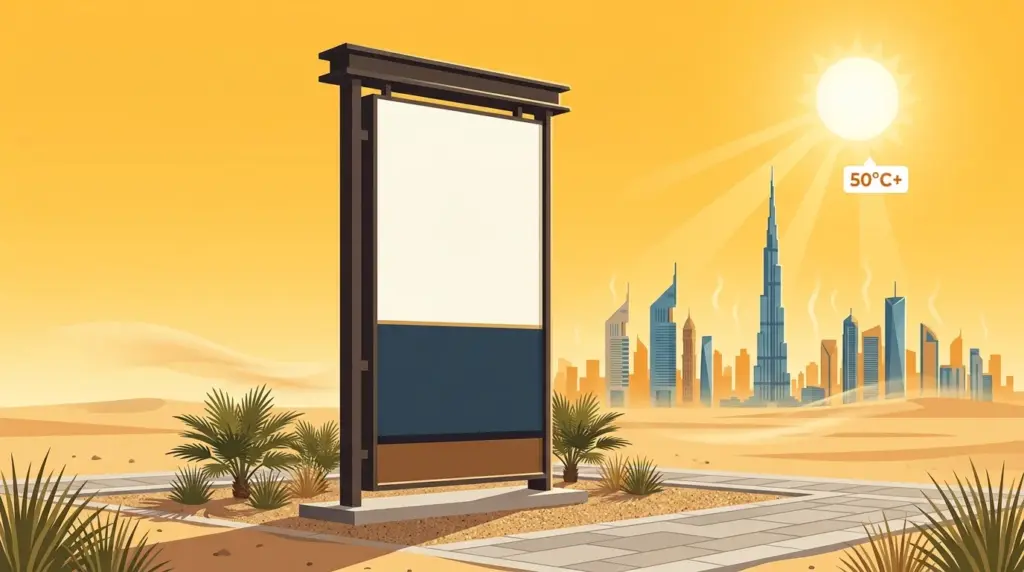
Dubai is one of the harshest environments in the world for exterior signage. A sign here faces four stresses at once: summer surface temperatures past 50°C, strong year-round UV, humidity and salt air near the coast, and blowing sand and dust.
This changes what “outdoor grade” means. Standard vinyl fades, untreated wood cracks, and cheap plastics warp within months. Signs that last use UV-grade acrylic, ACP, aluminium, and stainless steel near the coast, with sealed, heat-rated LEDs inside anything illuminated. The extra cost of the right material is almost always less than replacing a failed sign a year later, and a faded outdoor sign also reflects poorly on the brand behind it.
Permits and Rules for Outdoor Signs in Dubai
Outdoor signs in Dubai are regulated, and installing one without approval risks fines and forced removal. A few rules matter most:
- A permit is usually required. Most outdoor signage needs a Dubai Municipality advertising permit before installation, with the exact authority depending on location and sign type.
- The name must match the licence. The business name on the sign must match your DED or DET trade name exactly.
- Arabic is mandatory. Outdoor signs must include Arabic text, generally given prominence alongside English.
- Size follows frontage. Sign dimensions must be proportional to the building frontage, and signs above 2.5 meters usually need a structural review.
For the full process, see our guide on signage approval in Dubai. Handling this approval as part of the signage order is what keeps a project moving, rather than leaving a business to chase paperwork separately.
Working With Bab Al Mashriq
Bab Al Mashriq designs, manufactures, and installs outdoor signage across Dubai and the wider UAE, from channel letters and pylons to lightboxes, blade signs, and fascia signs. Fabrication is in-house across every physical material an outdoor sign needs, matched to the UAE climate so the sign lasts, with sealed LED lighting where it needs to be lit and Dubai Municipality approvals handled as part of the order.
To discuss an outdoor sign, call +971 52 97 92 557 for a quote.
Frequently Asked Questions
What is considered an outdoor sign?
An outdoor sign is any sign built for the exterior of a building or site to identify, advertise, or guide people to a business. This includes channel letters, pylon and monument signs, blade signs, lightboxes, fascia signs, banners, window graphics, and vehicle graphics. What sets them apart is that they are engineered to survive weather.
How do illuminated outdoor signs work?
Illuminated outdoor signs use a light source, almost always LED, either inside the sign or aimed at it from outside. Internally lit signs can be front-lit, where the face glows, or halo-lit, where light spills onto the wall behind for a soft outline. Lightboxes push light through a printed translucent face for an even, bright panel.
What is the best material for an outdoor sign in Dubai?
For signs that must last, ACP, aluminium, and stainless steel hold up best against heat, UV, and humidity, with stainless preferred near the coast. Lit faces should use UV-grade acrylic, and graphics should use cast, UV-rated vinyl. The common thread is choosing a heat and UV rated grade, not a budget version that fades fast.
Do outdoor signs need a permit in Dubai?
Yes, most outdoor signage in Dubai needs a Dubai Municipality advertising permit before installation, and installing without one risks fines and removal. The name on the sign must match your trade licence, Arabic is required, and the exact authority depends on location and sign type.
How big should the letters on an outdoor sign be?
It depends on viewing distance. The further away the sign is read from, the taller the letters need to be, which is why a roadside pylon uses much larger text than a shopfront read from the pavement. High contrast and a short, bold message also make a sign readable in the seconds a driver or walker has.
What is the difference between front-lit and halo-lit signs?
Front-lit signs glow across the face of the letters, giving a bold, bright look. Halo-lit, or back-lit, signs throw light onto the wall behind the letters, creating a soft glowing outline that reads as more premium. Both use LED, and the choice is mainly about the look you want.
- Outdoor signs are exterior signs that identify, advertise, or guide people to a business.
- They work through a mix of lighting, durable materials, and visibility design, which is what separates them from indoor signs.
- Illumination is usually LED, either internal (front-lit or halo-lit) or external, so signs stay visible at night.
- Common types include channel letters, pylon, monument, blade, lightbox, fascia, banners, window, and vehicle signs.
- In the Dubai climate, only UV and heat rated materials like ACP, aluminium, stainless steel, and UV-grade acrylic last outdoors.
- Most exterior signs in Dubai need a Dubai Municipality permit, must include Arabic, and must match the trade licence name.