
Safety signage is a set of standardized signs that warn people of hazards, tell them what they must or must not do, and point them to safety equipment and exits. There are five types under the ISO 7010 standard: prohibition (red), warning (yellow), mandatory (blue), safe condition (green), and fire safety (red). Each has a fixed colour and shape so it is understood at a glance. In the UAE, safety signs are legally required to be bilingual, in Arabic and English.
Safety signage is any sign designed to protect people by communicating a hazard, a rule, or the location of safety equipment. It uses fixed colours, shapes, and symbols so the message is clear in a split second, even to someone who cannot read the text. You see it on construction sites, in factories, in offices, and in public buildings, and in the UAE it must appear in both Arabic and English.
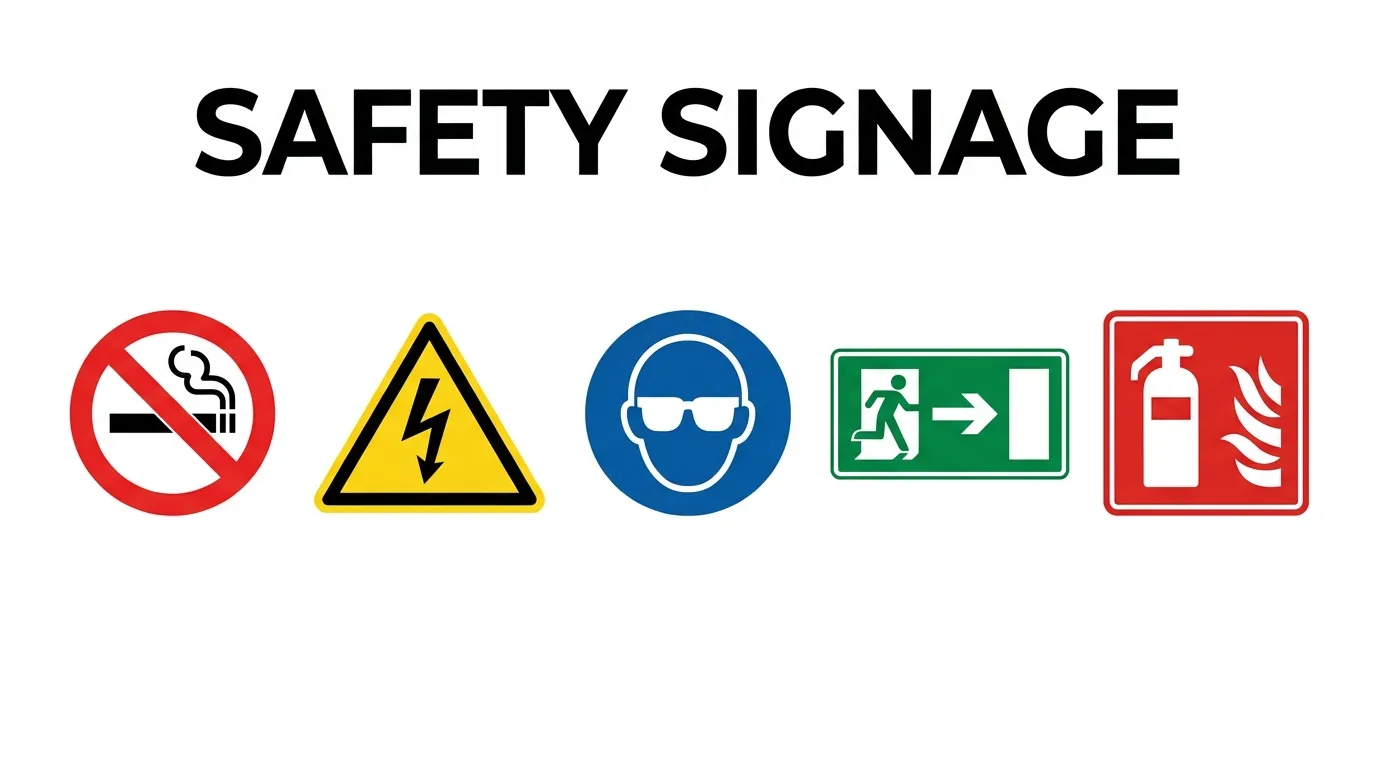
What Is Safety Signage?
Safety signage is visual communication built around one goal: preventing harm. Instead of relying on words alone, it uses a system of colours, shapes, and internationally recognised symbols so that anyone can read the meaning quickly, regardless of the language they speak.
That system is set by the international standard ISO 7010, which defines the symbols, and ISO 3864, which defines the safety colours and shapes. Together they are the reason a fire exit sign looks the same in Dubai as it does in Berlin or Tokyo. The UAE aligns its safety signage with these ISO standards, then adds a local requirement that the text appear in Arabic as well as English.
The key idea is that a safety sign should work even if no words are read at all. A red circle with a line through it means “do not,” wherever you are.
The Purpose of Safety Signage
Safety signs exist to prevent accidents before they happen. Its job is to give a person the right information at the right moment, so they avoid a hazard, take a required precaution, or find their way out in an emergency.
It serves a few clear purposes:
- Warning of danger. It alerts people to hazards they might not otherwise notice, like a wet floor, live electricity, or an overhead load.
- Directing behaviour. It tells people what they must do, such as wearing a helmet, and what they must not do, such as smoking near flammable material.
- Guiding escape. In an emergency, it points to exits, assembly points, and firefighting equipment.
- Meeting the law. In the UAE and most countries, correct signage is a legal requirement, and its absence carries fines and liability.
One point matters: signage supports safety measures, it does not replace them. A “Wet Floor” sign does not remove the hazard, it warns people while the floor is dealt with.
The 5 Types of Safety Signs and Their Meanings
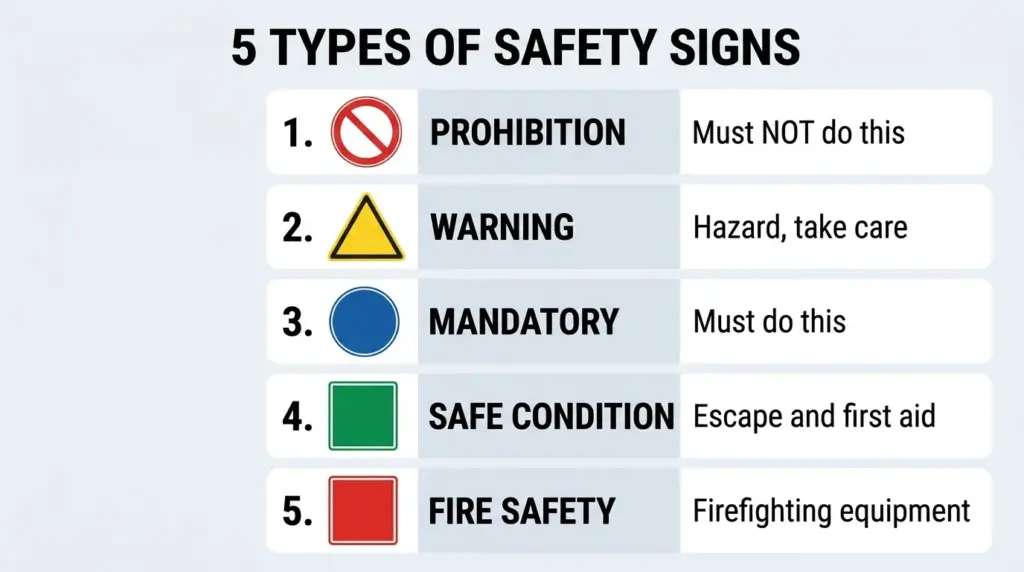
Under ISO 7010, every safety sign falls into one of five categories. Each has a fixed colour and shape, so a person recognises the type of message before they even read the symbol. This table is the quickest way to understand the whole system:
| Type | Meaning | Colour | Shape | Example |
|---|---|---|---|---|
| Prohibition | You must NOT do this | Red | Round, with a diagonal bar | No smoking, no entry |
| Warning | Hazard, take care | Yellow | Triangle, black border | High voltage, wet floor |
| Mandatory | You MUST do this | Blue | Round | Wear a helmet, wear a vest |
| Safe condition | Safety, escape, first aid | Green | Square or rectangle | Emergency exit, first aid |
| Fire safety | Firefighting equipment | Red | Square | Fire extinguisher, alarm |
Here is what each type covers in more detail.
1. Prohibition Signs (Red)
Prohibition signs tell people not to do something dangerous. They are a red circle with a diagonal bar across a black symbol on a white background.
- Meaning: An action is forbidden.
- Examples: No smoking, no entry, no access for unauthorised persons, no open flame.
2. Warning Signs (Yellow)
Warning signs alert people to a hazard nearby so they can take care. They are a yellow triangle with a black border and a black symbol.
- Meaning: Danger or hazard ahead.
- Examples: Electrical hazard, slippery floor, flammable material, overhead load.
3. Mandatory Signs (Blue)
Mandatory signs tell people what they must do, usually about protective equipment. They are a solid blue circle with a white symbol.
- Meaning: A specific action or precaution is required.
- Examples: Wear eye protection, wear a hard hat, wear high-visibility clothing, wash your hands.
4. Safe Condition Signs (Green)
Safe condition signs, sometimes called emergency signs, show the way to safety. They are green squares or rectangles with a white symbol.
- Meaning: This is the safe route or safety equipment.
- Examples: Emergency exit, escape route, assembly point, first aid station.
5. Fire Safety Signs (Red Square)
Fire safety signs mark firefighting equipment. They are red squares with a white symbol, which is what separates them from round red prohibition signs.
- Meaning: Firefighting equipment is located here.
- Examples: Fire extinguisher, fire hose reel, fire alarm call point.
Safety Sign Colours and Shapes Explained
The colour and shape of a safety sign carry meaning on their own, before you read the symbol. This is deliberate, so a person understands the type of message from across a room.
- Red means stop, forbidden, or fire equipment.
- Yellow means caution or hazard.
- Blue means a mandatory action.
- Green means safety, escape, and first aid.
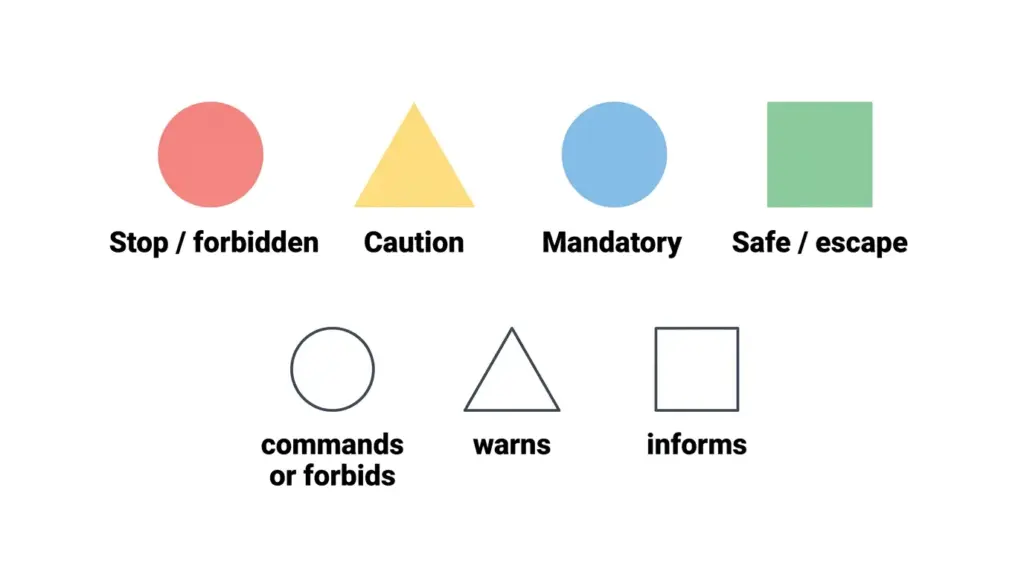
Shapes reinforce the colour. Round signs command or forbid, triangles warn, and squares or rectangles inform or guide. Under ISO 3864, the safety colour must cover a set minimum area of the sign, which keeps signs consistent and easy to recognise. This colour-and-shape logic is why a worker who speaks neither Arabic nor English can still read a "no entry" or "fire exit" sign correctly.
Safety Signage Requirements in the UAE
The UAE has strict, enforced rules for safety signs, and they differ from other countries in one important way: language.
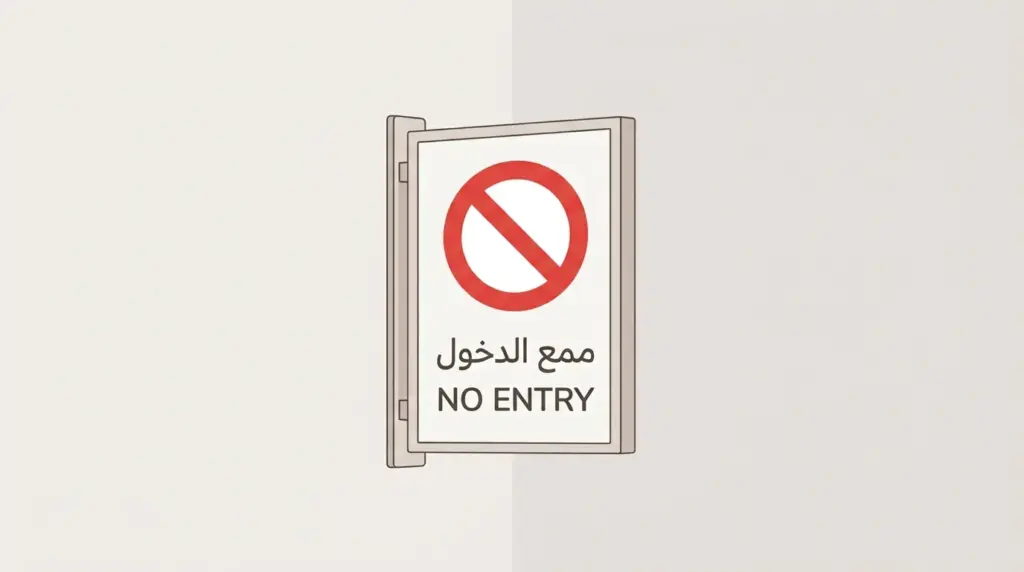
Bilingual signs are mandatory. Safety signage in the UAE must appear in both Arabic and English, with Arabic typically given prominence. This is a legal requirement under UAE Cabinet Resolution No. 49 of 2009, supported by federal labour law requiring that workers receive safety information in a language they understand. A sign only in English does not meet the requirement, and it fails its purpose for the large share of the workforce who read Arabic rather than English.
ISO 7010 symbols are the standard. UAE sites align their pictograms, colours, and shapes with ISO 7010, so the symbols match international practice.
Enforcement is real. Safety signs are checked by Dubai Municipality, the Civil Defence authorities, and, in Abu Dhabi, the Occupational Safety and Health Center (OSHAD) under its framework. Inspectors verify that required signs are present, legible, and current, and that faded or damaged signs have been replaced. Dubai Law No. 7 of 2025 further tightened contractor safety obligations, so the rules are getting stricter, not looser.
Safety Signage on Construction Sites
Construction sites are where safety signs matter most, because the hazards are constant and the workforce is large and multilingual. A UAE site needs signage from every category at once: mandatory PPE signs, hazard warnings, prohibition signs, and emergency route signs.
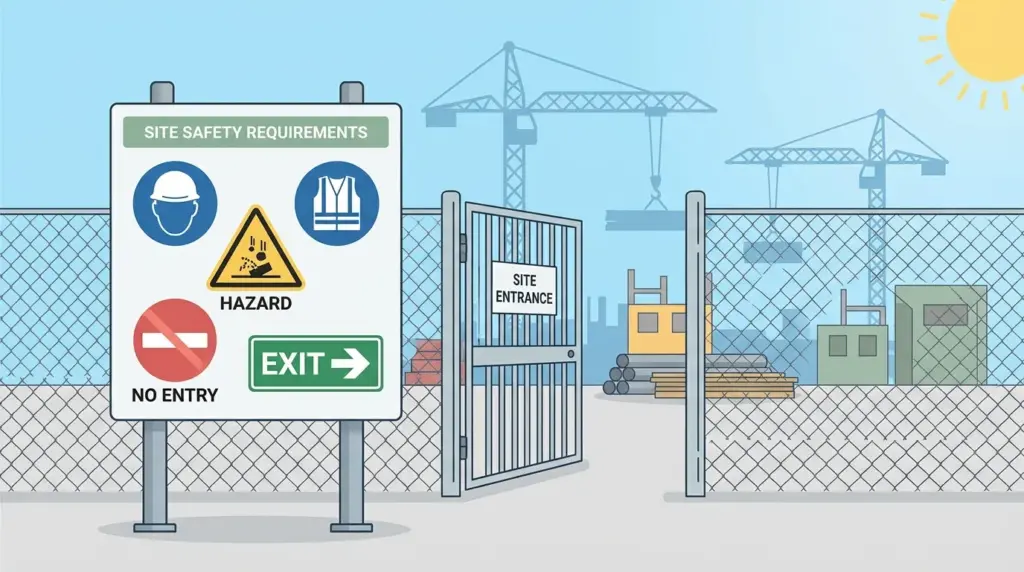
Typical construction safety signs include:
- Mandatory (blue): hard hat, safety boots, high-visibility vest, and eye protection must be worn.
- Warning (yellow): deep excavation, overhead load, falling objects, moving machinery.
- Prohibition (red): no unauthorised entry, no smoking, no naked flame.
- Safe condition and fire (green and red): assembly points, first aid, fire extinguishers, and escape routes.
On UAE sites, these must be bilingual, use ISO 7010 pictograms, and be made from UV-resistant materials so they stay legible in direct sun rather than fading within a season. Inspectors from Dubai Municipality check that signs match current site conditions, so signage for a finished phase has to be removed or updated. Bab Al Mashriq produces the full range of construction signage for sites across Dubai and the UAE, built to these bilingual and durability requirements.
Materials and Placement
A safety sign only works if it can be seen and read when it is needed, so material and position matter as much as the design.
- Photoluminescent material is used for fire and escape signs so they glow and stay visible if the power fails during an emergency.
- UV-resistant printing and materials are important for any outdoor sign in the UAE, since strong sun fades lower-grade signs quickly, and a faded safety sign can fail an inspection.
- Placement should be at eye level, well lit, and unobstructed, positioned where the hazard is or where the decision is made, not hidden around a corner.
For durable outdoor safety signs, common materials include aluminium, ACP, and rigid board with UV-stable, sometimes reflective, printing. For interior use, PVC and acrylic are typical.
Safety Signage With Bab Al Mashriq
Bab Al Mashriq designs, manufactures, and installs safety and compliance signage across Dubai and the wider UAE. The signs follow ISO 7010 symbols and the mandatory Arabic and English bilingual format, and they are produced in UV-resistant and photoluminescent materials suited to the UAE climate and to Civil Defence and municipality requirements.
Because fabrication is in-house across every physical material, safety signs can be matched to the site, whether that is an office interior, a factory, or an active construction project, and installed as a complete, inspection-ready set. To discuss a safety signage requirement, call +971 52 97 92 557 for a quote.
Frequently Asked Questions
What are the 5 types of safety signs?
The five types under ISO 7010 are prohibition signs (red, must not do), warning signs (yellow, hazard ahead), mandatory signs (blue, must do), safe condition signs (green, exits and first aid), and fire safety signs (red square, firefighting equipment). Each has a fixed colour and shape for instant recognition.
What do the safety sign colours mean?
Red means stop, forbidden, or fire equipment. Yellow means caution or a hazard. Blue means a mandatory action you must take. Green means safety, escape routes, and first aid. The colour tells you the type of message before you read the symbol.
Do safety signs in the UAE need to be in Arabic?
Yes. Safety signage in the UAE must be bilingual in Arabic and English, with Arabic usually given prominence. This is a legal requirement under UAE Cabinet Resolution No. 49 of 2009, and federal law requires workers to receive safety information in a language they understand. English-only safety signs do not meet the requirement.
What is ISO 7010?
ISO 7010 is the international standard that defines safety sign symbols, working with ISO 3864, which sets the safety colours and shapes. It is why a fire exit or no smoking sign looks the same worldwide. UAE safety signs align with ISO 7010 so its pictograms match international practice.
What safety signs are required on a construction site in the UAE?
A UAE construction site needs mandatory PPE signs (helmet, vest, boots, eye protection), hazard warnings (excavation, overhead loads, machinery), prohibition signs (no unauthorised entry, no smoking), and emergency signs (assembly points, first aid, fire equipment, escape routes). All must be bilingual, use ISO 7010 symbols, and be UV-resistant for the climate.
Why are some fire and exit signs made to glow in the dark?
Fire and escape signs are often made from photoluminescent material so they stay visible if the power fails during an emergency. When lighting is lost, a glowing exit or fire extinguisher sign still guides people to safety, which is exactly when it is needed most.
What is the difference between a fire safety sign and a prohibition sign, since both are red?
Shape is the difference. Prohibition signs are round with a diagonal bar and mean "do not." Fire safety signs are square and mark firefighting equipment like extinguishers and alarms. The colour is shared, but the shape tells you whether the sign forbids an action or points to fire equipment.
- Safety signage protects people by communicating hazards, rules, and escape routes using fixed colours, shapes, and symbols.
- The five types under ISO 7010 are prohibition (red), warning (yellow), mandatory (blue), safe condition (green), and fire safety (red square).
- Colour and shape carry meaning on their own, so a sign is understood before the text is read.
- In the UAE, safety signs must be bilingual in Arabic and English by law, under Cabinet Resolution No. 49 of 2009.
- Signage is enforced by Dubai Municipality, Civil Defence, and OSHAD, and construction sites are inspected closely for correct, legible signs.
- Fire and escape signs use photoluminescent material, and outdoor signs need UV-resistant materials to survive the UAE sun.