
LED signage uses light-emitting diodes to illuminate or display content on signs. It covers two distinct categories: physical lit signs where LEDs light a fixed structure (channel letters, lightboxes), and digital LED displays where LEDs form a programmable screen showing changing content. LEDs replaced neon and fluorescent lighting because they run cooler, last longer, and use less power. In Dubai, outdoor LED signs need at least 5,000 nits of brightness to stay visible in direct sun, an electrical compliance certificate, and a Dubai Municipality permit.
LED signage is any sign that uses light-emitting diodes as its light source. That covers a wide range: the glowing letters above a shopfront, the backlit panel in a pharmacy, and the programmable screen on a highway billboard are all LED signs, but they work differently and suit different needs. Understanding which type you need and how it performs in the UAE climate is where most buying decisions get made well or badly.
What Is LED Signage?
An LED (light-emitting diode) is a semiconductor component that produces light when electrical current passes through it. It replaced older sign lighting technologies, neon gas tubes and fluorescent lamps, for a few practical reasons:
- Neon used fragile glass tubes, high voltage, and gas under pressure. It was expensive to repair, dimmed gradually over time, and ran hot.
- Fluorescent lamps yellowed with age, had short tube life, distributed light unevenly, and contained mercury.
- LED runs on low voltage, produces very little heat relative to its brightness, lasts far longer, and can be shaped, coloured, and sealed in ways neon and fluorescent cannot.
That shift matters especially in the UAE, where heat shortens the life of any component that runs warm, and where sign maintenance access on a high facade is expensive.
How LED Signage Works
The light source
Each LED is a tiny semiconductor chip. When current flows through it, electrons move across a junction in the chip and release energy as light. The colour of the light depends on the materials in the chip. Red, green, and blue LEDs can be combined to produce any colour in the visible spectrum, which is how a full-colour LED display works.
In a physical illuminated sign, individual LEDs or LED strip modules are mounted inside the sign body behind a face. In a digital LED screen, millions of tiny LED clusters, each a pixel, are arranged in a grid and controlled individually by software to form images, text, and video.
Brightness: nits and why they matter in Dubai
Brightness of an LED sign is measured in nits (candelas per square metre). The ambient light around the sign determines how bright the LEDs need to be to make the content readable.
- Indoor signs typically run between 800 and 3,000 nits, calibrated to indoor ambient light.
- Outdoor signs in typical conditions need around 3,000 to 5,000 nits.
- Outdoor signs in Dubai’s direct sun need a minimum of 5,000 nits, and sun-facing screens on south or west facades often need 6,000 to 8,000 nits to stay readable at midday.
An indoor-spec screen installed outdoors in Dubai becomes effectively invisible in daylight. This is one of the most common and expensive specification errors on UAE projects.
Pixel pitch: resolution and viewing distance
Pixel pitch is the distance in millimetres between the centre of one LED pixel and the next. A smaller pitch means more pixels per square metre, a sharper image, and a shorter minimum viewing distance before the image looks smooth rather than pixelated.
The viewing distance drives the pitch decision:
- P2 to P3: High resolution for close viewing, 2-6 metres. Corporate lobbies, retail displays, indoor video walls.
- P4 to P6: Mid-range for signs viewed at 6-20 metres. Roadside signs, semi-outdoor screens.
- P6 to P10: Lower resolution for large outdoor signs viewed at 20 metres or more. Highway billboards, large building facades.
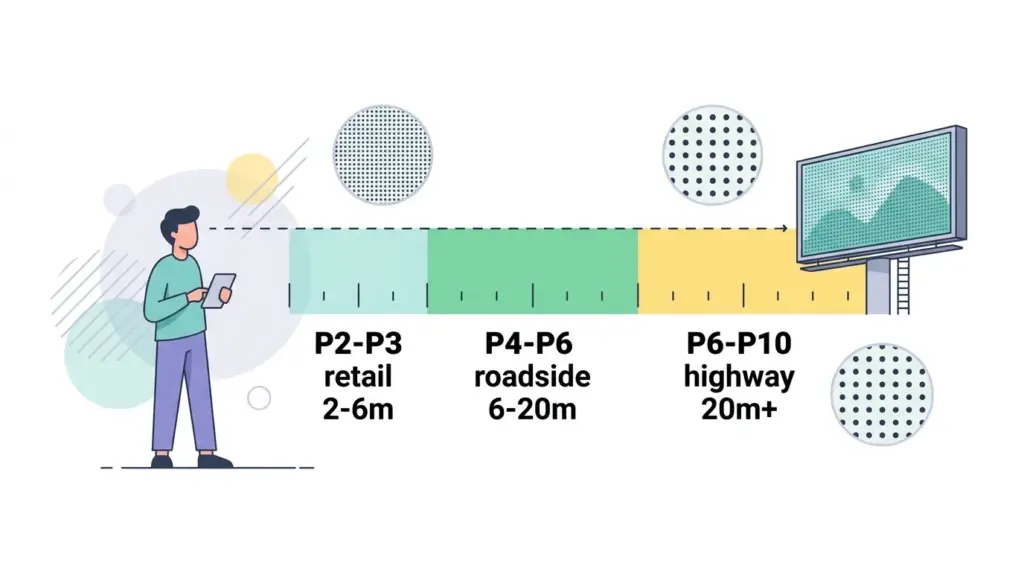
Choosing too fine a pitch for a long-distance billboard wastes budget on resolution nobody can see. Choosing too coarse a pitch for a close-viewing retail display produces a visibly pixelated image.
Thermal management
Heat shortens LED life and causes colour shift and failure. Outdoor LED signs in Dubai face surface temperatures that can exceed 60°C on south-facing facades in July. Well-engineered outdoor LED signs manage this through passive heat sinking, sealed cabinets, and where necessary active cooling, so the LED modules stay within their rated operating temperature. A sign without thermal management designed for the UAE climate degrades faster and needs earlier replacement.
Types of LED Signs
LED signs fall into two broad categories that are often confused: physical illuminated signs (where LEDs light a fixed structure) and digital LED displays (where LEDs form a programmable screen). Each category has distinct types.
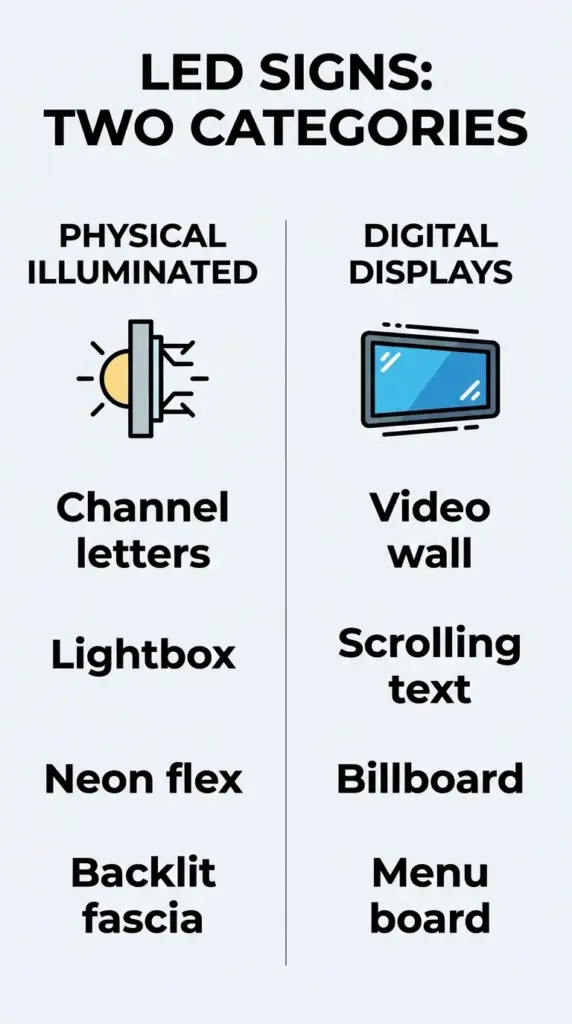
Physical Illuminated LED Signs
These signs have a fixed shape and message. The LEDs provide the light. Content does not change without physically changing the sign.
Channel letter signs are individual 3D letters, each with its own housing and LED module inside. They mount directly on a wall or fascia and are the most common premium illuminated sign for retail and restaurants. Three lighting styles:
- Front-lit: Light comes through the face of the letter. Bold, bright, and readable at distance.
- Halo-lit (back-lit): Light spills onto the wall behind the letter, creating a soft glowing outline. A more premium, refined look.
- Combination-lit: Both face and halo lit at once, for maximum impact.
Lightbox signs are sealed rectangular or shaped cabinets with a translucent face illuminated evenly from behind by LED strips. They are the workhorse of retail signage, used in pharmacies, cafés, clinics, and retail chains. The face can be printed or changed without replacing the whole sign.
LED neon flex is a flexible silicone strip that mimics the glow and curves of traditional glass neon, powered by LED. It is safer, lighter, and more durable than glass neon, and works well for decorative interior signs, logos, and branded displays. It does not break like glass and can be bent into custom shapes.
Backlit fascia panels are large flat panels with LED behind a face material, used for shopfronts and building cladding where an even, branded glow across the whole surface is wanted.
Digital LED Displays
These signs show changing content controlled by software. The LEDs form the pixels of a screen.
LED digital display screens are programmable screens that show video, animation, text, and images updated remotely or on-site through a content management system. They suit any environment where the message changes regularly.
LED scrolling text signs display text that scrolls across a strip of LEDs, common in banks, clinics, and petrol stations for announcements and pricing.
Video walls are large LED screens built from tiled panels, used in corporate lobbies, event venues, and exhibition stands for high-impact visual presentations.
Outdoor LED billboards are large-format digital screens on roadside structures, rented to advertisers and managed by outdoor media operators. In Dubai these require separate permits from Dubai Municipality and the RTA.
LED menu boards are digital screens that display food menus and pricing, allowing restaurants and cafés to change content instantly without reprinting.
What LED Signs Are Used For
Businesses use LED signs for a few clear purposes:
- Brand identity and shopfront presence. Channel letters and lit lightboxes carry a brand and make it visible day and night from the street.
- Changing promotions and pricing. Digital displays and menu boards let a business change its message without replacing a sign, reducing the cost and friction of regular updates.
- Roadside and highway visibility. Outdoor LED billboards and pylon displays capture drivers from a distance, at brightness levels that compete with direct sun.
- Interior engagement. Video walls and lobby screens hold attention and carry rich content in corporate, retail, and hospitality spaces.
- Menu presentation. LED menu boards in quick-service restaurants cut printing costs and let pricing and availability update in real time.
Outdoor LED Signs in Dubai: What the Climate Demands
Dubai is one of the hardest environments in the world for outdoor electronics. Every specification decision for an outdoor LED sign in the UAE needs to account for four factors that do not apply in cooler, less sunny markets:
- Brightness. Direct Dubai sunlight requires a minimum of 5,000 nits outdoors, with 6,000 to 8,000 nits for sun-facing facades. Below this the content disappears at midday.
- IP rating. IP65 is the minimum for all outdoor electronics: fully dust-tight (critical in a desert environment) and protected against water jets. IP67 adds submersion resistance for coastal or storm-exposed locations.
- Thermal management. Surface temperatures on south-facing building facades in Dubai can exceed 60°C in summer. An outdoor LED screen needs active thermal management to keep the electronics within operating range. An indoor-spec screen installed outdoors in the UAE typically fails within one to two years.
- UV resistance. The polycarbonate module covers and cabinet paint used for outdoor LED signs must be UV-stabilised to prevent yellowing and cracking under constant strong sun.
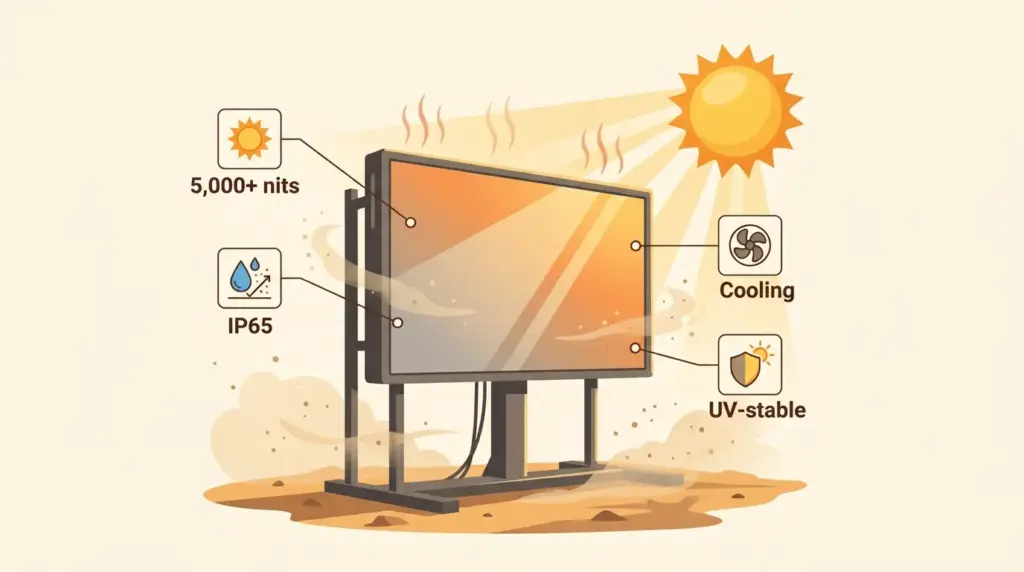
Getting any of these four wrong produces a sign that is either invisible in the day, failed within a year, or both.
Permits and Rules for Outdoor LED in Dubai
Outdoor LED signs and digital displays face a more detailed approval process than static signs, because they add lighting and content variables to the standard permit requirements.
- Dubai Municipality permit. All outdoor signs, including LED-illuminated ones, need a DM advertising permit before installation.
- RTA involvement. Digital screens and LED signs visible from public roads require Roads and Transport Authority clearance in addition to DM approval.
- Electrical compliance certificate. Illuminated and LED signs must obtain an electrical compliance certificate from the relevant authority. Some locations also require a light impact assessment to demonstrate the sign will not cause glare hazard or light pollution.
- Brightness and dimming. Some DM zones require automatic brightness dimming between specified evening hours to limit light pollution. The sign must be capable of dimming automatically, not just manually.
- Arabic and English. Content on outdoor LED signs must include Arabic and English, with Arabic equal in size or more prominent, matching the standard rule for all commercial signage in the UAE.
- Size proportional to facade. Screen dimensions must be proportionate to the building facade and cannot obstruct pedestrian access or sightlines.
Physical Illuminated LED Signs vs Digital LED Displays
This distinction matters for choosing the right supplier and the right sign.
A physical illuminated sign (channel letters, lightbox, neon flex) uses LEDs as the light source inside a fixed structure. The structure is manufactured once, installed, and typically maintained through the sign company that made it. These signs suit a permanent business identity that does not need to change.
A digital LED display uses LEDs as the pixels of a screen, controlled by software. The screen is a technology product, and the content is managed through a CMS, a cloud system, or a media player. These suits businesses whose message changes regularly, or who want to run video and animation.
The two are different products even though both say “LED.” A signage manufacturer who builds channel letters is not the same supplier as a company selling programmable digital screens, and choosing the wrong type for the need (or the wrong supplier for the type) is the source of most LED signage disappointments.
Working With Bab Al Mashriq
Bab Al Mashriq designs and manufactures physical illuminated LED signs in-house across Dubai and the UAE: channel letter signs in front-lit, halo-lit, and combination styles; LED-backlit lightboxes; LED neon flex signs; and backlit fascia panels. The fabrication covers the sign body, the LED specification, and the finish, with Dubai Municipality approvals handled as part of the order and installation and maintenance included.
For programmable digital display screens, video walls, and scrolling text boards, those are a separate product category supplied by digital screen specialists. If you are unsure which type fits your project, call +971 52 97 92 557 and the right recommendation will be clear once the use case is understood.
Frequently Asked Questions
What is the difference between LED signage and digital signage?
LED signage is any sign using light-emitting diodes, whether physical illuminated signs like channel letters or programmable digital screens. Digital signage specifically refers to programmable screens that display changing content via software. All digital signage uses LEDs, but not all LED signage is digital. A lit channel letter sign is LED but not digital.
Why do outdoor LED signs in Dubai need so many nits?
Dubai’s direct sunlight is intense enough to wash out a screen that would look bright indoors. An indoor-spec screen typically runs 800 to 3,000 nits. Outdoor screens in Dubai need a minimum of 5,000 nits, and sun-facing facades often need 6,000 to 8,000 nits to stay readable at midday. Below that threshold the content effectively disappears in daylight.
What is pixel pitch and how do I choose the right one?
Pixel pitch is the distance between LED pixels in millimetres. A smaller pitch gives sharper resolution at shorter viewing distances. For close retail displays at 2 to 6 metres, P2 to P3 is appropriate. For roadside signs seen from 20 metres or more, P6 to P10 is the right range. Choosing too fine a pitch wastes budget on resolution that cannot be seen at distance.
Do LED signs need a permit in Dubai?
Yes. All outdoor LED signs need a Dubai Municipality advertising permit. Those visible from public roads also need RTA clearance. Illuminated signs must obtain an electrical compliance certificate, and some zones require a light impact assessment. The approval process for LED signs is more detailed than for static signs.
What is the difference between front-lit and halo-lit channel letters?
Front-lit channel letters glow across the face for a bold, high-visibility look. Halo-lit letters throw light onto the wall behind them, creating a soft glowing outline with a more premium feel. Combination letters do both. The choice is mainly aesthetic, though front-lit tends to be more visible from a greater distance.
Why do outdoor LED signs in Dubai fail early?
The most common causes are under-specified brightness (indoor-spec screens that become invisible in daylight), lack of thermal management (electronics overheat when surface temperatures exceed 60°C), and insufficient IP rating (dust ingress in a desert environment). Correct specification from the start, matching the sign to the UAE climate, avoids these failures.
- LED signage covers two distinct categories: physical illuminated signs (channel letters, lightboxes) where LEDs light a fixed structure, and digital LED displays where LEDs form a programmable screen.
- LEDs replaced neon and fluorescent because they run cooler, last longer, use less power, and can be sealed and shaped more flexibly.
- Brightness is measured in nits. Outdoor LED signs in Dubai need a minimum of 5,000 nits, and sun-facing facades need 6,000 to 8,000 nits, to stay visible in direct sun.
- Pixel pitch determines resolution and minimum viewing distance. Smaller pitch suits closer viewing; larger pitch suits roadside and long-distance signs.
- Outdoor LED signs in Dubai must be IP65-rated, thermally managed, and UV-stabilised to survive the climate.
- Outdoor LED signs in Dubai require a Dubai Municipality permit, often RTA clearance, and an electrical compliance certificate.
- Content must be bilingual in Arabic and English, with Arabic equal or more prominent.