
Pylon signage is a tall, freestanding sign mounted on one or two steel poles, designed to be seen by drivers from a distance. It stands above traffic, trees, and buildings to give a business roadside visibility that a shopfront sign cannot. Common types include single-pole, twin-pole, multi-tenant, and illuminated pylons. In Dubai, pylon signs need a Dubai Municipality permit and, if road-facing, an additional RTA Signage NOC, plus structural engineering drawings with wind load calculations.
A pylon sign is a freestanding outdoor sign raised on one or two steel poles above the surrounding landscape. Unlike a fascia sign that sits on a building, a pylon stands on its own, in a car park, at a site entrance, or along a road, putting the business name where drivers can see it from hundreds of metres away. In Dubai, where showrooms, malls, business parks, and hotels sit on wide roads with fast-moving traffic, that distance visibility is often the difference between a customer turning in and driving past.
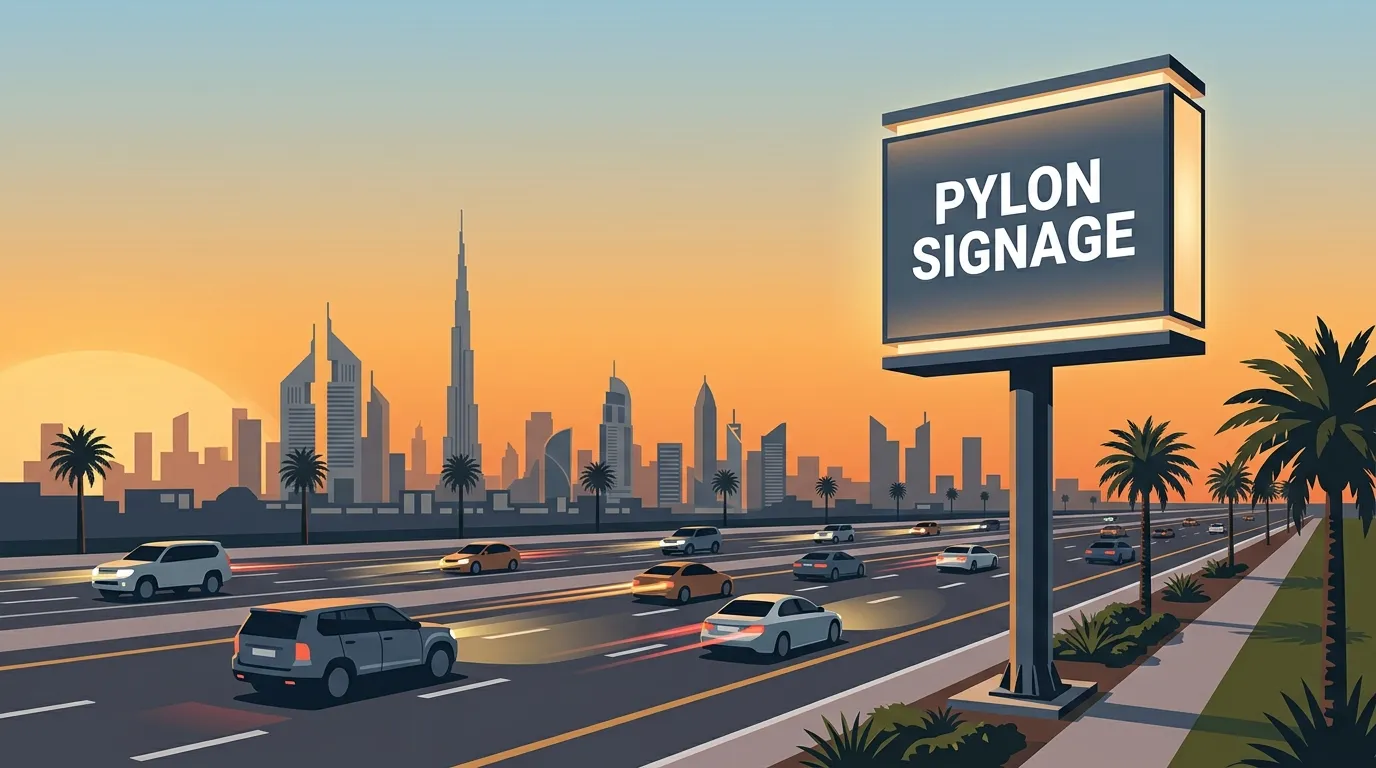
What Is Pylon Signage?
A pylon is a tall, freestanding structure built to communicate a business name or tenant list to road-level traffic from a significant distance. The defining characteristic is height: these signs rise above the visual clutter of parked cars, street-level landscaping, and nearby buildings so the face sits in clear sightlines from the road.
The word “pylon” describes the pole structure underneath. The visible part is the sign cabinet or face at the top. The cabinet can hold a single business name, a logo, or a list of multiple tenants, and it can be static, illuminated, or digital depending on the build.
Pylon signs in dubai are used where a business cannot be seen clearly from the road, either because it sits behind a car park, because other buildings obstruct the view, or because passing traffic moves too fast to read a shopfront sign. The pylon solves that by putting the name where drivers can read it early enough to slow down and turn.
How a Pylon Is Built
This is what separates a pylon from other large outdoor signs, and why it needs engineering rather than just fabrication.
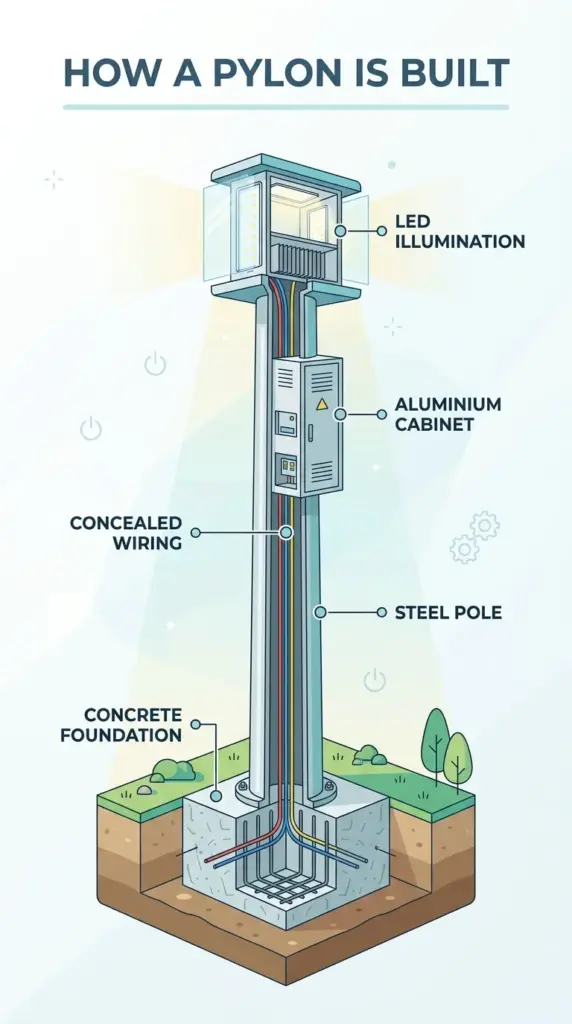
Foundation
A pylon starts underground. The poles are embedded into a concrete foundation, with depth and diameter calculated from the sign’s height, weight, and the wind load it must resist. A taller or wider sign creates more bending force at the base in high wind, which the foundation and pole gauge must be built to handle. In Dubai, structural drawings must include wind load calculations specifically compliant with the Dubai Building Code, including resistance to sandstorm conditions. A sign erected without these calculations will not pass DM review.
The pole or poles
The pole is a steel tube, single or paired depending on the design, rising from the foundation to the display height. All electrical wiring for illuminated signs runs inside the pole, concealed from public view, which is a specific Dubai Municipality requirement. External conduit on the outside of a pylon pole fails inspection.
The sign cabinet
The cabinet mounts at the top of the pole. It is typically an aluminium box with a translucent or printed face, lit from within by LED strips or modules. Multi-tenant signs use a series of interchangeable panels stacked in the cabinet, one per business, with a frame system that lets individual panels be swapped without affecting the others.
Illumination
Most pylons are internally illuminated. LED modules inside the cabinet project light through the face evenly, keeping the sign visible after dark and in poor weather. The wiring runs through the pole to a sealed junction at the base connected to mains power. Illuminated pylons in Dubai require a DEWA no-objection certificate before they can be switched on.
The Main Types
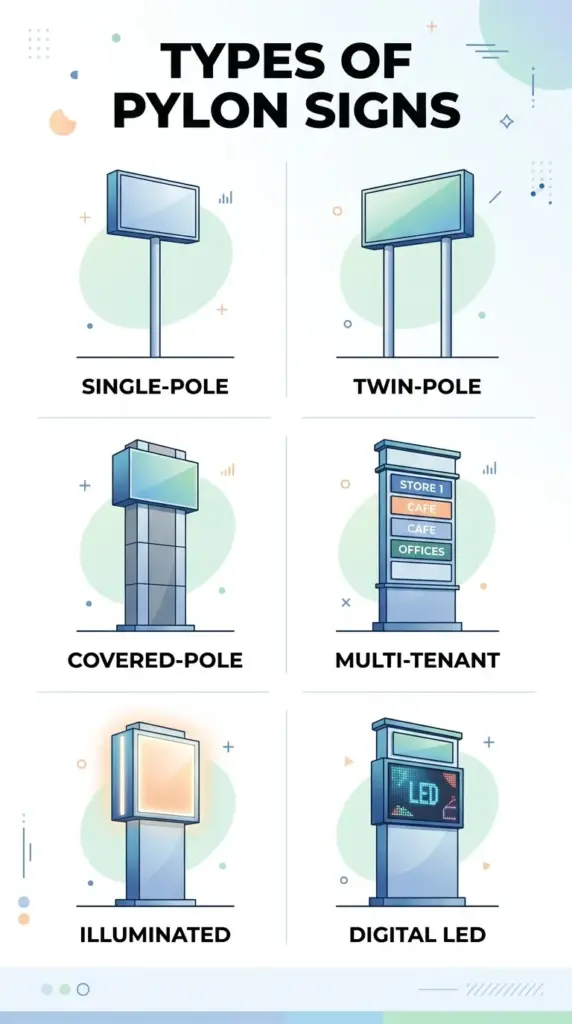
Single-pole pylon
The most common form: one vertical steel pole supporting the display cabinet. It is space-efficient, clean in appearance, and simpler to install than a twin-pole. Single-pole pylons suit sites with limited ground footprint and are the standard choice for petrol stations, standalone restaurants, and roadside businesses.
Twin-pole pylon
Two poles, one on each side of the cabinet, provide greater stability for heavier or wider cabinets. Twin-pole designs handle stronger winds better and can support larger multi-tenant displays. They are common at shopping strips, business parks, and large commercial properties where the cabinet carries several tenant panels and needs the additional lateral strength.
Covered-pole (decorative) pylon
The structural poles are concealed inside a decorative casing, typically clad in aluminium, brick, concrete, or stone. The finish makes the sign look more architectural and premium by hiding the raw steel. Hotels, corporate campuses, and upmarket retail developments often choose this style when the sign needs to match the quality of the building behind it.
Multi-tenant pylon
A multi-tenant pylon carries interchangeable panels in a stacked frame, one for each business on the property. Shopping centres, business parks, and mixed-use developments use them to give every tenant road-level visibility from a single structure. When a tenant changes, only their panel is replaced. The structure is owned by the property, not the individual businesses.
Illuminated pylon
Any of the above types can be internally or externally illuminated. Internal LED illumination is the standard for new builds: it delivers even light across the face, runs efficiently, and works inside a sealed cabinet that protects the electronics from heat and dust. External floodlights, mounted at the base or on a bracket, light the sign face from outside and suit non-cabinet signs like dimensional letters on a covered pole.
Digital LED pylon
A growing number of pylon signs now incorporate a digital LED display panel in place of or alongside the static cabinet face. The digital section shows programmable content, promotions, pricing, or tenant information that updates remotely. Digital sections in road-facing pylons in Dubai require additional RTA clearance, and brightness must meet the limits that prevent glare into traffic.
Key Benefits
- Distance visibility. The height puts the sign above everything that would otherwise block it: parked cars, hedges, lower buildings. A well-placed pylon can be read from several hundred metres away, giving drivers time to anticipate and turn.
- Landmark function. A permanent, tall sign at a site entrance becomes a reference point. Customers direct others by it, and it reduces missed turns for first-time visitors.
- Around-the-clock presence. An illuminated pylon works in the dark and in poor weather, making the business visible during every hour it operates and after hours when brand recall still matters.
- Multi-tenant value. For property owners, a pylon that lists all tenants makes the site more attractive to businesses and removes the need for each tenant to install separate roadside signage.
- Durability. Built from steel poles and aluminium cabinets with proper wind-load engineering, a pylon is designed for years of outdoor exposure without constant maintenance.
- Brand visibility at road speed. A simple, large sign face with high contrast reads quickly by a driver moving at 60 to 80 km/h, which is the key constraint pylon design is built around.
Where They Are Used
Pylon signs appear wherever road-level distance visibility is the primary requirement:
- Petrol stations and service stations. Height and illumination make pricing and brand visible at road speed.
- Shopping malls and retail strips. A multi-tenant pylon lists all businesses on the property, giving smaller tenants roadside presence they could not achieve individually.
- Business parks and office complexes. A pylon at the main entrance identifies the development and its tenants to visitors arriving by road.
- Hotels and resorts. Road-facing pylons guide guests to an entrance that may sit back from the road.
- Car showrooms. Showrooms set behind a forecourt need height to put the brand name where passing drivers can see it over the parked stock.
- Hospitals and clinics. Medical facilities use pylons to be identifiable quickly for patients and ambulances navigating to the correct entrance.
- Restaurants and fast food. Highway-adjacent locations rely on pylons to catch drivers before the turn-off decision.
Pylon Signage in Dubai: Permits and Rules
Pylon signs carry the most detailed approval process of any common sign type in Dubai, because they are large structures in public view, often road-facing, and always structurally engineered.
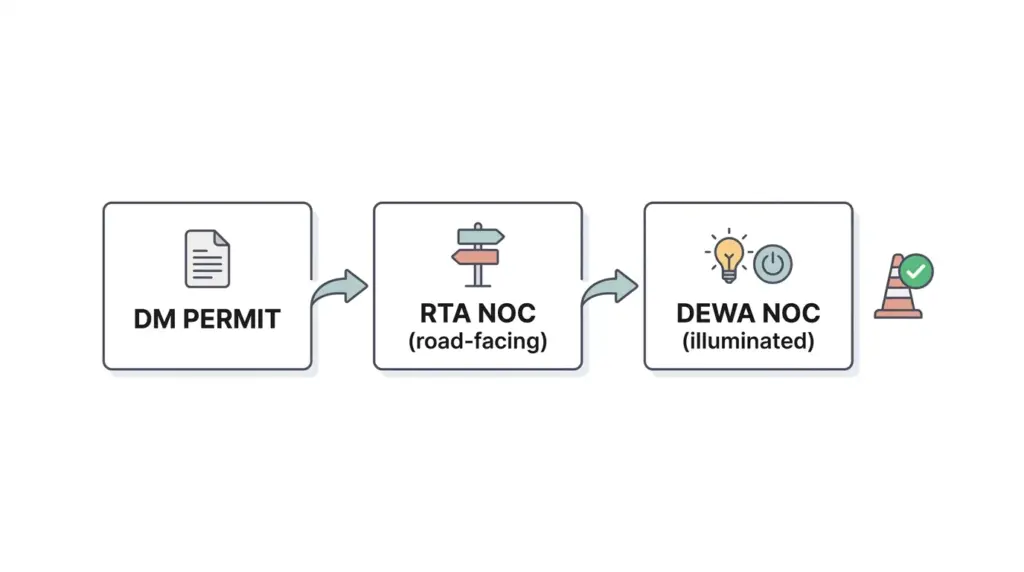
Dubai Municipality advertising permit. All outdoor signs, including pylons, require a DM advertising permit under Municipal Order No. 4/2019 before installation. The application requires a site plan, scaled sign drawings, a mock-up perspective, the trade licence, a landlord NOC, and crucially for pylons, certified structural engineering drawings.
RTA Signage NOC. Any pylon visible from or adjacent to a public road requires an RTA (Roads and Transport Authority) Signage NOC in addition to the DM permit. These are two separate approvals from two separate authorities. A business that secures the DM permit but skips the RTA NOC faces removal and fines of AED 5,000 to 50,000 for the unauthorised sign.
Structural engineering drawings. Unlike a flat fascia sign, a pylon requires certified structural calculations covering foundation depth and diameter, pole gauge, and wind load resistance. The Dubai Building Code requires that freestanding outdoor structures demonstrate they can withstand UAE wind loads and sandstorm conditions. These drawings are submitted as part of the DM application and reviewed before the permit is issued.
DEWA NOC. Illuminated pylons need a DEWA (Dubai Electricity and Water Authority) no-objection certificate confirming the electrical connection and wiring meet safety standards before the sign is switched on.
Commercial zones only. Freestanding pylons are permitted only in designated commercial zones. A pylon in a zone where they are not allowed will not receive DM approval regardless of how well it is designed.
Arabic and English. Content must be bilingual, with Arabic text equal in size or more prominent than English, and the name must match the DET trade licence exactly.
Timeline. Standard applications clear in four to eight weeks. Applications that require RTA sign-off typically take longer. Submitting incomplete drawings or going to the wrong authority for the site’s zone is the most common cause of delays.
Bab Al Mashriq handles the DM and RTA approval process as part of a pylon order, preparing structural drawings, managing the submission, and coordinating between authorities, so the sign reaches installation rather than sitting in review. To discuss a pylon project, call +971 52 97 92 557 for a quote.
What Is the Difference Between Pylon and Monument Signs?
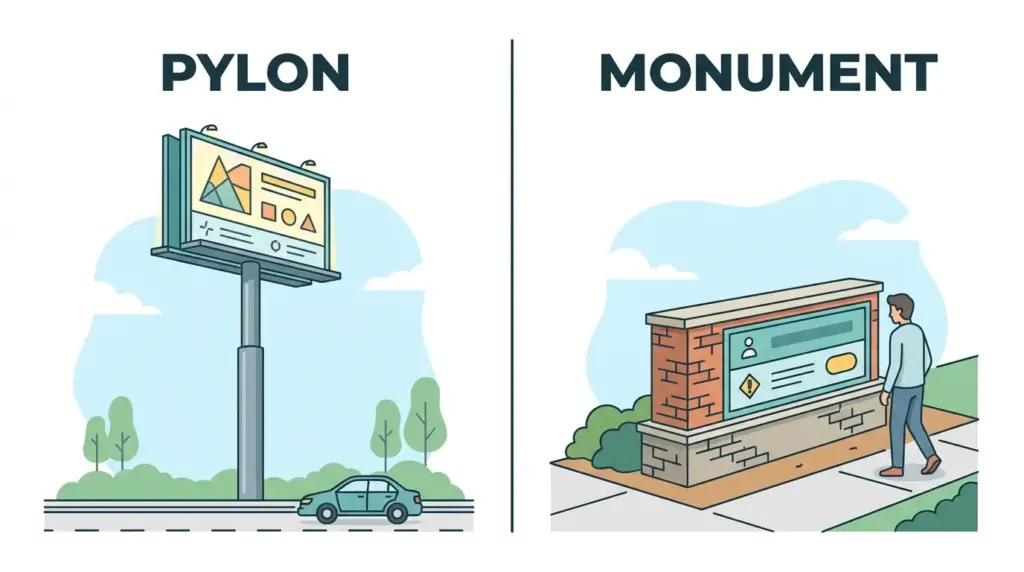
Pylon and monument signs are both freestanding outdoor signs, but they are built for different purposes and different viewing distances, and they work in fundamentally different ways.
Height. A pylon sign is tall, typically six metres or more, designed to rise above traffic, landscaping, and nearby structures so drivers can see it from the road. A monument sign is low-profile, usually under two metres, sitting close to the ground where it is read by people who are already on the property or entering it.
Structure. A pylon stands on exposed or covered steel poles embedded into a concrete foundation. A monument sign sits on a solid base built from masonry, brick, concrete, stone, or cast aluminium. The base is architectural, designed to blend with the landscaping and entrance rather than rise above it.
Viewing distance and audience. Pylons work at road speed: they are built so a driver at 80 km/h can read them far enough in advance to slow down and turn. Monument signs work at walking speed or slow vehicle entry: they are read by someone already pulling into a driveway or walking up to an entrance.
Tenancy. Pylons frequently carry multiple tenant panels in a stacked frame, since their road-level visibility serves everyone on the property. Monument signs almost always carry a single business name or property name, because their audience is already on site.
Permits in Dubai. A road-facing pylon in Dubai needs both a DM advertising permit and an RTA Signage NOC, plus structural engineering drawings. A monument sign typically needs a DM permit and landlord NOC but does not usually trigger RTA involvement, since it sits at the entrance rather than addressing road traffic.
When to choose which. If the business sits back from the road and relies on drivers recognising it before the turn, a pylon solves the problem. If the entrance and identity are the priority for someone already on the property, a monument sign fits better. Many large commercial sites use both: a pylon for road visibility and a monument at the entrance for identification.
Frequently Asked Questions
What is the standard height for a pylon sign?
There is no single standard: height is determined by site requirements, local zoning rules, and DM approval. In Dubai, the maximum permissible height depends on the zone and building frontage, and structural drawings for the specific height must be submitted. Most commercial pylons run between six and fifteen metres, with highway-adjacent signs sometimes taller subject to RTA approval.
Do pylon signs need a permit in Dubai?
Yes, and typically two permits. A Dubai Municipality advertising permit is required for all outdoor signs. If the pylon is visible from a public road, an additional RTA Signage NOC is required. Illuminated pylons also need a DEWA NOC before they can be switched on. Installing without these permits risks fines of AED 5,000 to 50,000 and forced removal at the owner’s cost.
What is a multi-tenant pylon sign?
A multi-tenant pylon carries a stacked set of interchangeable panels, one for each business on a property. When a tenant changes, only their panel is replaced. Property owners use them at shopping strips, business parks, and mixed-use developments to give every tenant roadside visibility from a single structure.
How long does pylon sign approval take in Dubai?
Most straightforward DM applications clear in four to eight weeks. Adding RTA sign-off for road-facing pylons extends this. Delays are almost always caused by incomplete structural drawings, incorrect zone applications, or missing the landlord NOC. Having all documents complete before submission is what keeps the timeline on track.
Can a pylon sign be digital?
Yes. Digital LED panels can replace or sit alongside a static cabinet face in a pylon. A digital pylon requires the same DM and RTA approvals as a static one, plus the digital content must meet the brightness and content standards that prevent glare into traffic. Remote content management systems let the message update without physical access to the sign.
What materials are pylon signs made from?
The structural poles are steel, sized and gauged to the engineering calculations. The display cabinet is typically aluminium for light weight and weather resistance. Sign faces use UV-stable printed media or translucent acrylic for illuminated versions. Decorative covered-pole builds use cladding in aluminium, brick, concrete, or stone over the steel structure.
- Pylon signage is a tall, freestanding sign on one or two steel poles, designed to put a business name where drivers can read it from a distance.
- The engineering behind a pylon: embedded foundation, concealed wiring through the pole, and a wind-load calculation required by the Dubai Building Code.
- Common types include single-pole, twin-pole, covered-pole, multi-tenant, illuminated, and digital LED pylons.
- Benefits include distance visibility, landmark presence, 24/7 illuminated operation, multi-tenant value, and durability.
- Common uses: petrol stations, malls, business parks, hotels, showrooms, hospitals, and highway-adjacent restaurants.
- In Dubai, pylon signs need a DM advertising permit plus an RTA Signage NOC if road-facing, structural engineering drawings, and a DEWA NOC if illuminated.
- Unauthorised pylon installation risks fines of AED 5,000 to 50,000 and forced removal at the owner’s cost.