Bab Al Mashriq designs, fabricates and installs building signage in Dubai like name signs, facade and tower letters, rooftop, pylon and lobby signs for commercial, residential and government buildings. We get the landlord’s consent and the permit before fabrication starts, and our team installs at any height.
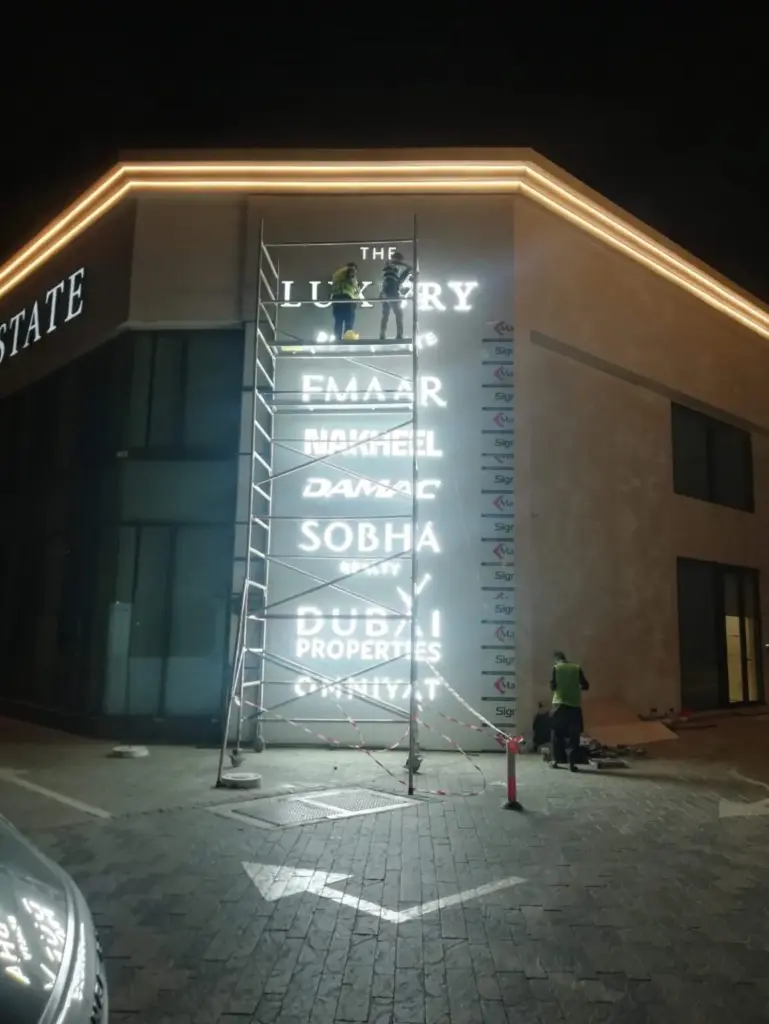
| Typical cost | AED 1,500 for an entrance name sign to AED 100,000 or more for a lit tower crown sign, before permits |
| Timeline | 4 to 6 weeks for an entrance sign, 6 to 12 weeks for facade or tower letters, approvals included |
| Approvals | Landlord or developer consent, then Dubai Municipality or the free zone authority; DEWA for lit signs; RTA for signs in the road right of way |
| Installation height | No limit. We use cranes, building maintenance units (BMU) and rope access |
| Workshop | Showroom No. 7, Ajman Industrial 2 |
Building signage is the set of permanent signs that identify a building and help people find their way around it: the name on the facade, entrance and pylon signs, lobby directories, and floor and unit numbers. It is usually ordered by the developer, the building owner, the facility manager or the owners’ association. Sometimes an anchor tenant with naming rights orders the main facade sign.
It is not the same as construction signage, which is temporary and goes up on an active site as project boards, safety signs and hoarding. It is also different from a tenant’s shopfront sign, which sits on the tenant’s own frontage and follows the building’s signage rules.
We make ten kinds of building signs:
3D signage letters and logos fixed to the facade, lit or non-lit, usually in aluminium or stainless steel.
Large letters at the top of a tower, sized to be read from far away and mounted on a galvanised steel frame.
Names on the parapet wall or along the podium edge, inside the zone the building allows for signs.
Letters on or above the main entrance canopy, often halo-lit so they glow against the wall at night.
Freestanding pylon signs at the plot entrance or driveway, with the building name and, on mixed-use plots, tenant panels.
The building name or logo behind the concierge desk, in brushed metal, acrylic or 3D letters. See our reception signage page for options.
Lobby boards with changeable name strips, so a new tenant means a new strip, not a new board.
Lift lobby floor numbers, corridor arrows and door numbers that work as one wayfinding signage system.
Level indicators, bay numbers, height clearance bars, loading bay and plant room signs.
Number plates for villas, plots and buildings in metal or acrylic.
The exit, evacuation and fire equipment signs that Dubai Civil Defence inspects come from our safety signs range, and we fit them in the same visit.
The signs a building needs depend on who uses it. A commercial tower needs a name sign and a tenant directory, a residential building needs entrance, floor and apartment numbering, and a government building needs bilingual signs built to the entity’s own brand rules.
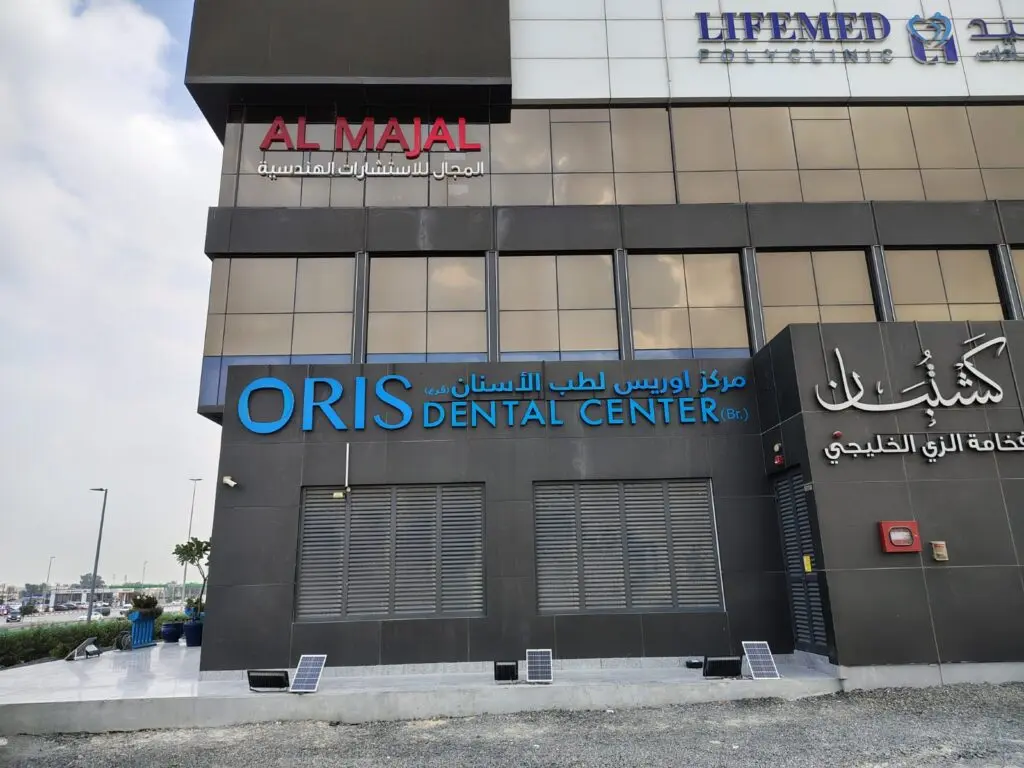
An office building sign or commercial building usually needs a building name sign, tenant names or logos on the facade where the landlord allows them, an entrance or pylon sign, and a lobby directory that is easy to update. Facade naming rights normally go to the developer or an anchor tenant. Other tenants follow the landlord’s signage criteria, which fix the zone, size and lighting of each sign, and they need the landlord’s NOC before any permit application. For signs inside a tenant’s own unit, see our office signage in Dubai.
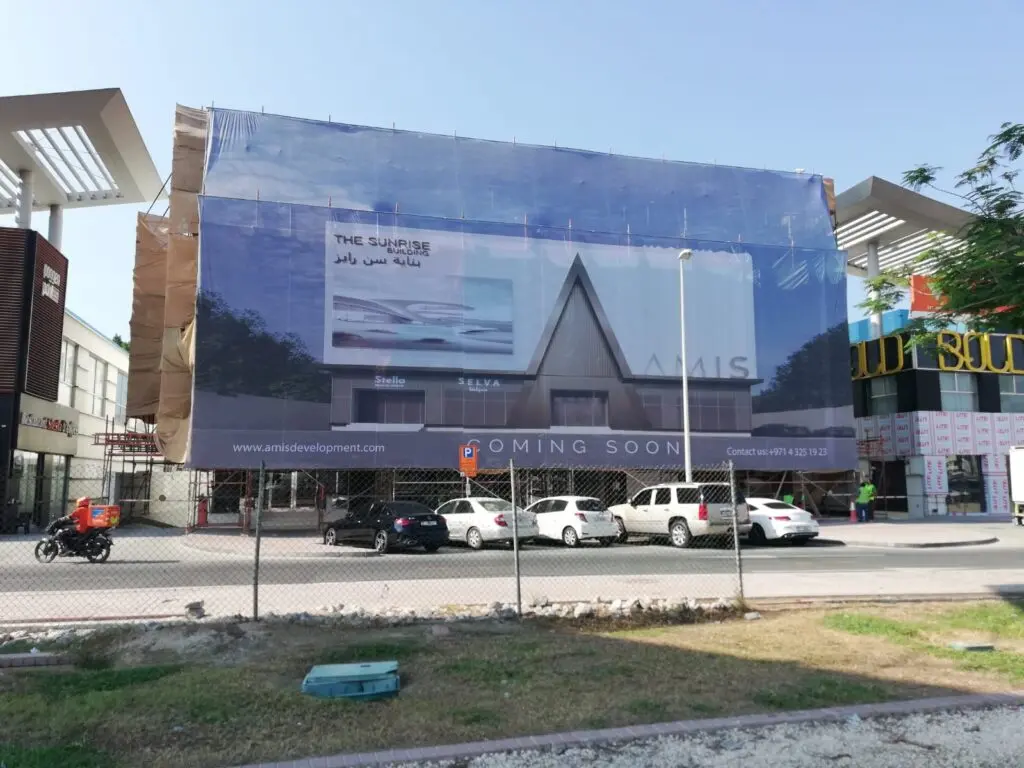
A residential tower or community needs a building name sign, entrance markers, lobby and floor signs, apartment or villa numbers, car park signs and Civil Defence exit signs. In a master community, the master developer’s design guidelines and the owners’ association’s approval come before the permit, so we check both at the first site visit. We also keep one numbering scheme from the plot number to the unit number. Residents, visitors and delivery drivers then read the same numbers at the gate, in the lift and on the door.
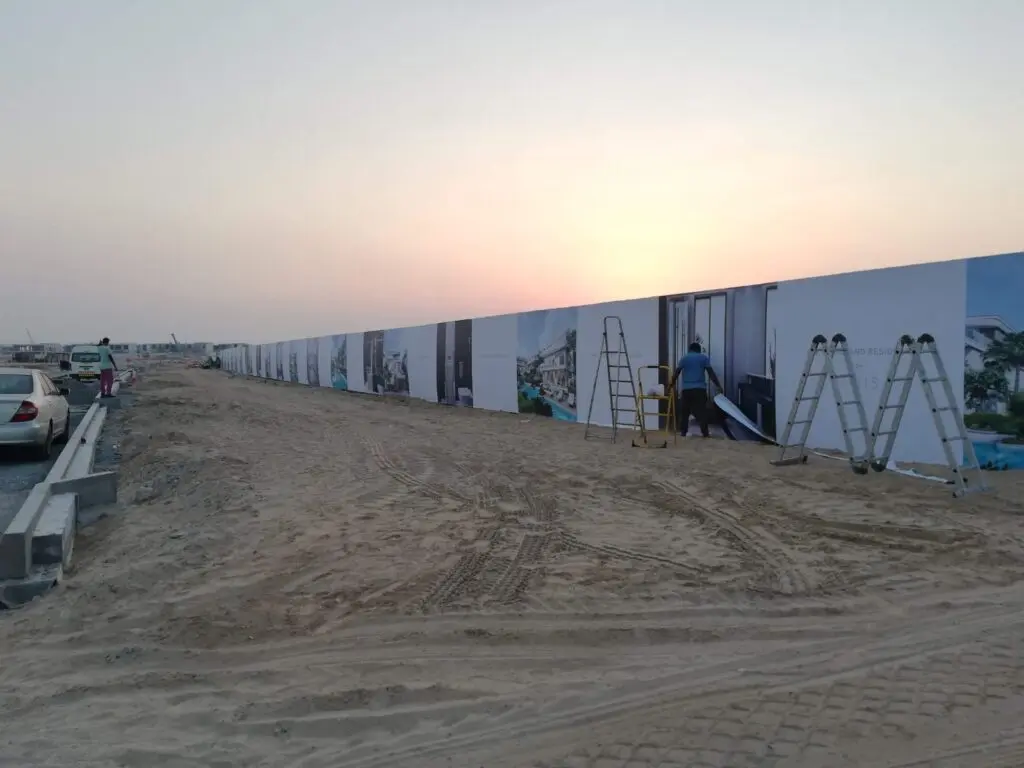
Government buildings in Dubai need bilingual signs with Arabic as the main language, built to the entity’s brand guidelines and the tender specification. Dubai’s advertising regulation, Decree No. (6) of 2020, sets Arabic as the main language on signs, taking at least 50% of the sign and placed at the top or on the right-hand side. The entity’s own guidelines then set the typeface, the colours and how the emblem is used.
We work from the tender specification and the approved sign schedule. Before fabrication we submit shop drawings, material samples and a mock-up for the consultant or the entity to approve, and we complete the entity’s supplier registration when a project requires it. Accessibility signs follow the Dubai Universal Design Code, and safety signs use ISO 7010 symbols.
Building signage in Dubai costs from about AED 1,500 for an entrance name sign in 3D letters to AED 10,000 to 40,000 for facade or tower letters, and AED 100,000 or more for a lit high-rise crown sign, before permits.
| Sign | Typical range (AED) |
|---|---|
| Building number or name plaque | 300 to 1,500 |
| Entrance name sign in lit 3D letters | 1,500 to 8,000 |
| 3D front-lit letters | 300 to 800 per sq ft |
| Halo-lit (back-lit) letters | 400 to 900 per sq ft |
| Facade or tower name letters | 10,000 to 40,000+ |
| Pylon or full building sign, lit tower crown | 20,000 to 100,000+ |
| Lobby directory and wayfinding package | 5,000 to 25,000 |
These ranges follow published 2026 Dubai signage price guides and the rates on our outdoor signage in Dubai page. Letter height, lighting, the number of letters and the access needed decide where your sign falls in the range. The extras below are often left out of a first quote, so we list them on ours.
| Extra | Typical cost (AED) |
|---|---|
| Structural engineering certificate | 800 to 2,500 |
| DEWA permit and inspection for a lit sign | 500 to 2,000 |
| Scaffolding or cherry picker | 1,500 to 5,000 per day |
| Crane | 3,000 to 8,000 per mobilisation |
| Night installation | 20% to 30% on labour |
Height adds cost in three places:
The permit is a yearly fee paid to the authority on top of the sign price, and the authority depends on where the building is. Dubai Municipality covers signs on buildings in mainland Dubai. The Dubai Development Authority (DDA) and other free zone authorities cover signs inside their zones.
| Dubai Municipality (published permit rates) | Fee |
|---|---|
| Projected signboard (ground-floor shop sign) | AED 100 per sqm per year |
| Rooftop sign | AED 200 per sqm per year |
| Fixed trade-name plate | AED 500 per sqm per year |
| Pylon | AED 5,000 per year |
| DDA free zones (dda.gov.ae) | Fee |
|---|---|
| Rooftop sign, building wrap or wall-mounted banner | AED 5,000 per year |
| Podium parapet or roof parapet sign | AED 2,500 per year |
| Ground-floor shop sign | AED 500 per year |
| Knowledge Dirham and Innovation Dirham | AED 20 per transaction |
As an example, a 10 sqm rooftop sign on a mainland building carries a Dubai Municipality fee of 10 × AED 200, which is AED 2,000 a year. The same sign in a DDA zone costs AED 5,000 a year. Trakhees, DMCC and the DIFC Authority set their own fees. Every permit is renewed yearly.
Yes. Adding Arabic usually adds about 20% to 30% to fabrication cost because it roughly doubles the letter count. Arabic is not optional on most signs in Dubai, so we price both languages from the first quote rather than adding them later.
On a Dubai facade, use 316 stainless steel or powder-coated aluminium for letters, ACP for panels and cladding, and UV-stable acrylic or polycarbonate faces over IP-rated LEDs. Summer heat above 45°C, strong sun and salt air near the coast break down lower grades within a few years.
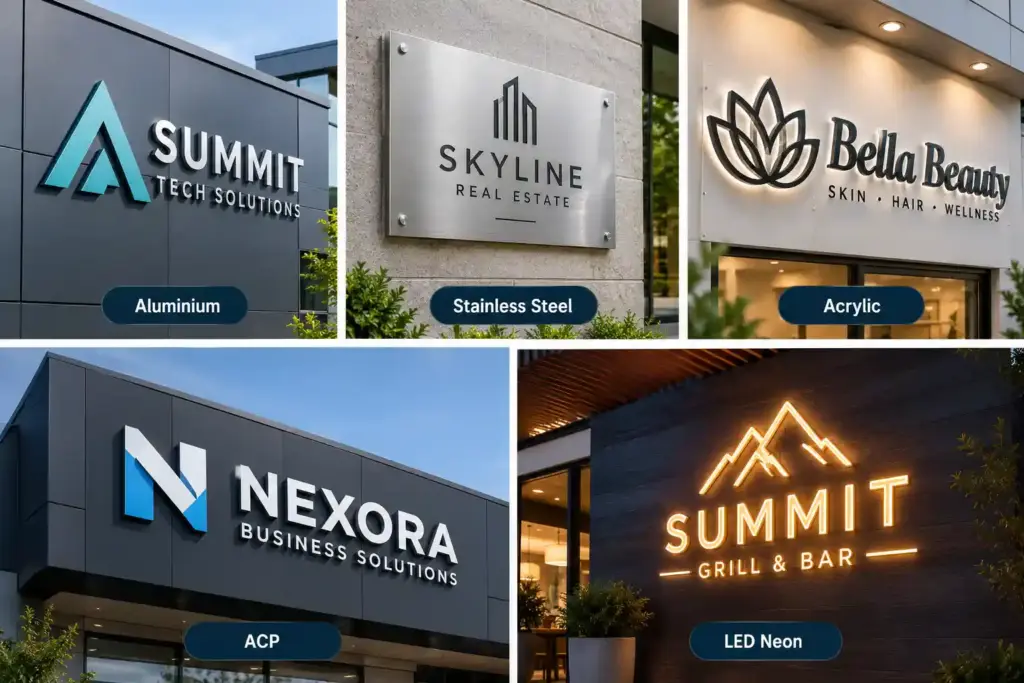
| Material | Best for | Why |
|---|---|---|
| 316 stainless steel | Buildings near the sea, Dubai Creek or Dubai Canal | Resists salt corrosion better than 304 grade |
| Powder-coated aluminium | Large letters at height | Light, does not rust, holds its colour |
| ACP (aluminium composite panel) | Sign panels and cladding behind letters | Flat, light and easy to cut to shape |
| Acrylic or polycarbonate faces | Lit letter faces | UV-stable grades do not yellow in the sun |
| Galvanised steel sub-frame | Rooftop and crown signs | Carries the wind load back to the structure |
Our signage materials guide covers each one in more detail.
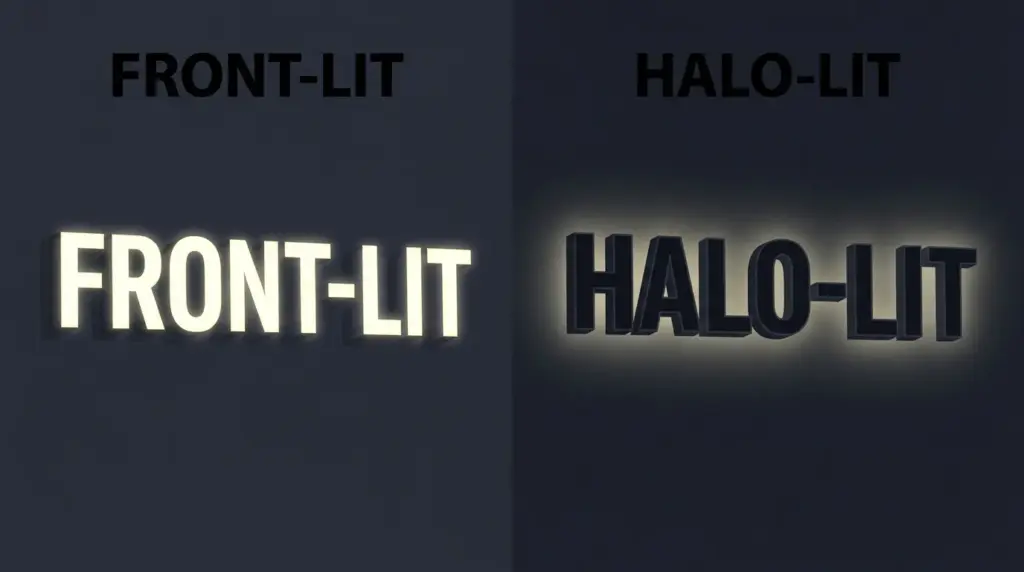
Channel letters are hollow 3D letters with metal sides, called returns, and a face on the front, lit by LEDs inside. They are the usual way to put a lit name on a building. Front-lit letters shine through the face and read best from a distance. Halo-lit letters shine backwards onto the wall and give a softer outline. Front-and-back-lit letters do both. Non-lit letters suit buildings with good facade lighting or a quieter look.
Size the letters for the distance people will read them from. A common sign-industry rule of thumb is about 25 mm of letter height for every 3 m of viewing distance for easy reading.
| Viewing distance | Letter height |
|---|---|
| 30 m (across the street) | 250 mm |
| 60 m (from the next plot) | 500 mm |
| 150 m (from a main road) | 1,250 mm |
The building’s signage zone and the permit drawings set the maximum size, so we check both before we size the letters.
As a building signage contractor, we take a building sign from survey to handover in seven steps, and nothing is fabricated before the permit is issued.
We check access, anchor points, the power supply and the distances people will read the sign from.
We place the sign on day and night photos of your facade so you can see it before you approve it.
A UAE-licensed structural engineer prepares and signs the wind-load calculations and the fixing details.
We collect the landlord or developer NOC, then apply to Dubai Municipality, the DDA or the free zone authority, plus DEWA for lit signs and the RTA where needed.
We build the letters and frames in our Ajman workshop and run every LED module before it leaves.
Our team carries out the building signage installation with a crane, a BMU or rope access, at any height. Where building management limits daytime work, we install at night or at weekends under the building’s permit to work and close off the area below.
You receive photos of the finished sign and a maintenance plan. Our signage maintenance team handles cleaning and LED checks after that.
When a new sign replaces an old one, we take the old letters and panels down, seal the fixing holes so water cannot get into the facade, and remove everything from site. Metal and LED parts go for recycling where possible.
Plan for 4 to 6 weeks for an entrance name sign and 6 to 12 weeks for facade or tower letters, including 10 to 20 working days for approvals.
| Stage | Typical time |
|---|---|
| Survey and design | About 1 week |
| Approvals | 10 to 20 working days |
| Fabrication | 2 to 4 weeks |
| Installation | 1 to 5 days |
A DDA permit is usually processed in about 4 working days once the application is complete. Landlord and master developer reviews take longer, so we start them in the first week.
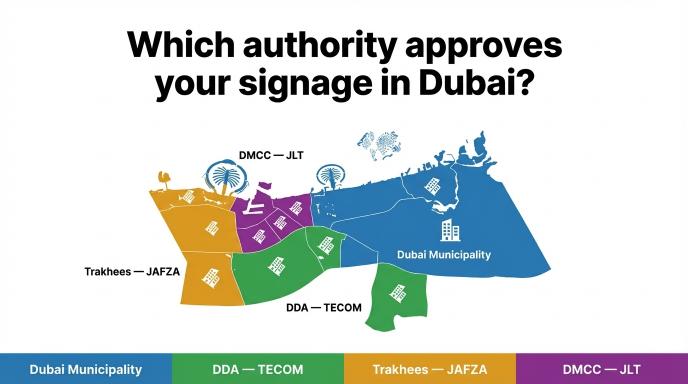
Every exterior building sign in Dubai needs the landlord’s or master developer’s consent first, then a permit from the authority for that area. Decree No. (6) of 2020 sets which authority issues the permit, based on where the sign is placed.
| Situation | Approval | Issued by |
|---|---|---|
| Any exterior sign | Consent or NOC | Landlord, master developer or owners' association |
| Sign on a building in mainland Dubai | Advertising permit | Dubai Municipality |
| Shop's own name sign on its facade | Advertising permit | Department of Economy and Tourism |
| Sign inside a free zone | Advertising permit | The zone's authority, such as the DDA, Trakhees, DMCC or the DIFC Authority |
| Sign in the road right of way | Approval | RTA |
| Lit or electrically connected sign | NOC | DEWA |
| Large or elevated sign | Structural calculations | UAE-licensed structural engineer |
A typical application includes the trade licence, the landlord or plot owner NOC, a contractor appointment letter, scaled artwork with dimensions and materials, a photo of the facade with the sign mocked up, and structural drawings for large or elevated signs. Our guide to signage approval in Dubai covers each authority step by step.
“Bab Al Mashriq executed our HQ branding project with precise adherence to our global identity guidelines. Their technical team resolved structural load challenges efficiently.”
“We required a top signboard supplier capable of delivering 200+ retail signs within a 30-day window. Bab Al Mashriq met the deadline without compromising material quality or finish.”
Building signage is permanent and goes on a finished building. Construction signage is temporary and goes on an active site as project boards, safety signs and hoarding. If your building is still going up, start with construction signage in Dubai and plan the permanent signs for handover. If you need a sign for a single shop or restaurant frontage, our outdoor signage page covers shopfront signs.
We install building signs across Dubai, from towers in Business Bay, Downtown Dubai and Dubai Marina to warehouses in Al Quoz and Ras Al Khor, villa communities in Jumeirah and Arabian Ranches, and free zone buildings in Dubai Media City and JAFZA. From our Ajman workshop we also cover Sharjah, Abu Dhabi and the northern emirates. See our outdoor signage in Business Bay page or all the areas we serve.

Yes. A building name sign needs the landlord’s or master developer’s consent, then a permit from Dubai Municipality on the mainland or from the free zone authority inside a free zone. A lit sign also needs a DEWA NOC.
Permanent building signs are usually recorded as a fixed asset and depreciated over their useful life, while temporary signs are usually expensed. Check the treatment for your company with your accountant.
A signage contractor designs, fabricates and installs signs and handles the approvals they need. For building signs, that also means structural calculations, access equipment and working within the building’s rules.
Yes. We work under the building’s permit to work, close off the area below the facade, and schedule noisy or high-level work at night or at weekends when building management asks for it.
Yes. We take the old sign down, seal the fixing holes and remove it from site. Metal and LED parts go for recycling where possible.
No. We install at any height using cranes, building maintenance units or rope access, with the fixings designed by a UAE-licensed structural engineer.
In the CSI MasterFormat system used in many construction specifications, signage sits in Division 10 (Specialties), section 10 14 00 Signage.
Send us a photo of your building and the sign you have in mind, and we will come back with a facade mock-up, a quote that lists permits and access costs, and a realistic timeline. Your building signage in Dubai is designed, approved, built and installed by one team. The site survey is free. Call or WhatsApp 055 397 5597.