
Every UAE workplace needs fire exit and fire equipment signs, first aid and emergency number signs, an assembly point sign, and the warning, mandatory and prohibition signs its own risk assessment calls for. Each one must be written so that most of the staff can understand it.
That applies well beyond building sites. Dubai Municipality’s Technical Guideline on Safety Signs at Work covers commercial and industrial businesses, government offices and construction sites alike (section 3). Below is the baseline set, then a checklist for seven common types of UAE workplace. Construction sites have the strictest rules, which we cover on our construction signage in Dubai page.
| Key fact | What applies |
|---|---|
| Symbol standard | ISO 7010 shapes, colours and pictograms |
| Dubai | DM Technical Guideline on Safety Signs at Work (DM-HSD-GU99-SSW2) |
| Abu Dhabi | ADOSH-SF Code of Practice 17.0, Safety Signage and Signals |
| Sharjah | OSHJ-CoP-35 Safety Signs and Signals, version 2, July 2024 |
| Fire and exit signs | UAE Fire and Life Safety Code |
| Language | One that most of the workforce understands (DM guideline, section E) |
| Training in Dubai | At least once a year, with records kept for five years (section N) |
What safety signs does every workplace need?
Whatever the business, six signs form the baseline. These are the safety signs every workplace needs before any hazard-specific sign:
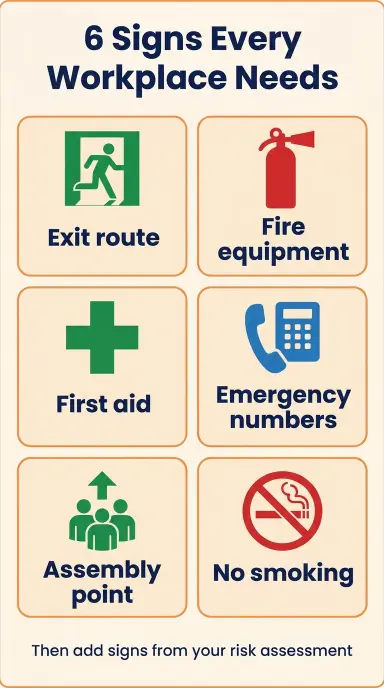
- Exit and escape route signs, lit or photoluminescent so they work in a power cut, placed under the UAE Fire and Life Safety Code.
- Fire equipment signs for extinguishers, hose reels and fire alarm call points.
- A first aid sign at the first aid point, with the names of the first aiders.
- Emergency numbers, posted where staff can see them.
- An assembly point sign outside, where people gather after an evacuation.
- No smoking signs wherever smoking is banned.
Everything else comes from the risk assessment. The DM guideline starts with hazard identification for this reason (section A): you choose the signs after you know the hazards. That is also why the boxed safety signs UAE online shops sell rarely fit a real workplace. For what each sign means, see our guide to types of safety signs.
Which rules apply to workplace safety signs in the UAE?
Workplace sign rules are set by each emirate. Fire and exit signs are the exception: they follow the UAE Fire and Life Safety Code everywhere.
| Emirate | Document | Who it covers |
|---|---|---|
| Dubai | DM Technical Guideline on Safety Signs at Work (2020) | All workplaces, including construction sites |
| Abu Dhabi | ADOSH-SF Code of Practice 17.0, Safety Signage and Signals | All employers in the emirate |
| Sharjah | OSHJ-CoP-35 Safety Signs and Signals (July 2024) | All entities in the emirate |
| Federal | Federal Decree-Law No. 33 of 2021 on labour relations | Employers’ duty to keep workers safe, overseen by MoHRE |
| Fire signs | UAE Fire and Life Safety Code | Exit, directional and fire equipment signs |
Exit signs have one more rule worth knowing. In DMCC, exit signs, directional signs and evacuation plans must be installed by a Civil Defence-approved contractor, under the supervision of a Civil Defence-approved consultant (DMCC Health and Safety Bulletin 05). Check with the authority for your own zone before you order them.
Safety sign checklist by workplace type
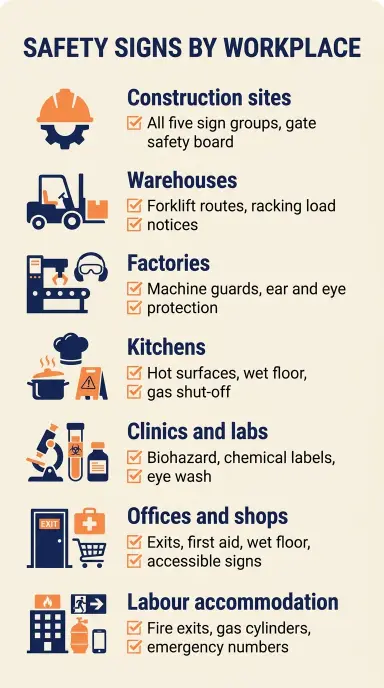
Most UAE workplaces fall into one of seven types, and each adds its own signs to the baseline set above. The items below are the typical signs a risk assessment calls for in each. Where a specific rule applies, we name it.
Construction and fit-out sites
Construction and fit-out sites need all five sign groups (prohibition, warning, mandatory, emergency and fire), a safety instruction sign at the gate, and wording in Arabic, English and the main language of the crew (Dubai Safety Guide for Construction Works, 6.2.3).
Fit-out work inside an occupied building adds its own hazards: hot work, dust, wet floors and members of the public walking past. Keep the public out of the work area with barriers and no-entry signs. Our guide to the mandatory safety signs for construction sites in the UAE covers the full rules.
Warehouses, logistics and loading bays
Warehouses need signs that keep people and forklifts apart. Typical signs include:
- marked pedestrian routes and crossing points
- forklift warning and speed limit signs
- racking load notices
- loading dock edge warnings
- hazard class signs on dangerous goods stores
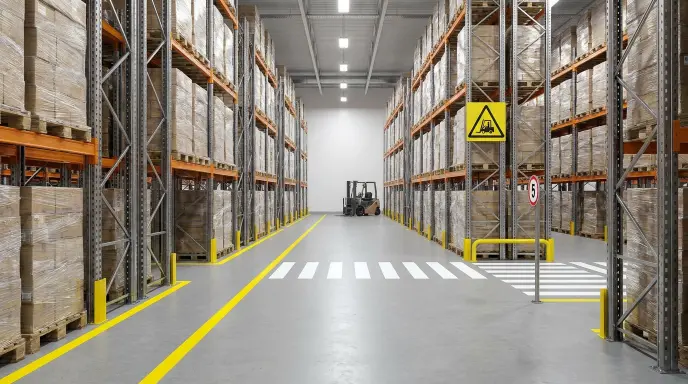
The DM guideline asks for access routes to be marked with continuous lines, preferably yellow or white (section K). Dangerous goods storage areas need hazard class and warning signs at clear points such as doors (section J).
Factories and workshops
Factories and workshops add machine and process signs: moving parts and guard warnings, ear and eye protection zones, lockout tags on equipment under repair, and labels on compressed gas and chemicals.
Containers and visible pipes holding dangerous goods must carry hazard and handling labels (DM guideline, section I). If you use acoustic alarms, the DM guideline asks for them to sound about 10 decibels above the background noise, and only one at a time (section H).
Restaurants and commercial kitchens
Kitchens need signs for hot surfaces, wet floors, the gas shut-off valve and the fire extinguisher or fire blanket near the cooking line, plus a hand-washing reminder. We found no UAE rule that lists kitchen signs on their own, so these come from the kitchen’s risk assessment. Check any food safety signs with your emirate’s food authority.
Clinics, labs and maintenance rooms
Clinics, laboratories and plant rooms need hazard signs at the point of use:
- biohazard and radiation warnings
- chemical labels on containers
- eye-wash and emergency shower signs
- authorised-persons-only signs on plant and electrical rooms
For health facilities in Dubai, the DHA Health Facility Guidelines say fire and exit signs follow the UAE Fire and Life Safety Code (Part C).
Offices, shops and customer areas
Offices and shops are low-hazard, but they still need exit and fire equipment signs, first aid and assembly point signs, and temporary wet-floor signs during cleaning.
They also need signs that work for people of determination. The DM guideline asks for extra measures where people have impaired sight or hearing, such as visual indicators or brighter signs (section E). Exit and directional signs must follow the Fire Code and the Dubai Universal Design Code (section L). Our page on braille signs explains tactile options.
Labour accommodation
Workers’ accommodation needs fire exit and extinguisher signs, warnings at gas cylinder areas, emergency numbers, and house rules in the residents’ own languages. In Sharjah, the SPSA code on workers’ accommodation (OSHJ-CoP-25) requires accommodation to comply with the UAE Fire and Life Safety Code. Check the rules in Dubai and Abu Dhabi with the authority that licenses your accommodation.
What languages must workplace safety signs use?
Use a language that most of your staff understand. The DM guideline gives Arabic and English as examples, and asks employers to consider the languages their employees actually speak and read (section E). On construction sites in Dubai, the rule is stricter: Arabic, English and the language most workers know (Safety Guide 6.2.3).
Don’t confuse this with the rule for shop and advertising signs. The requirement that Arabic covers at least 50% of a sign, at the top or on the right, comes from Decree No. 6 of 2020 (Article 11(7)) and covers trade-name and advertising signs. On safety signs, the pictogram carries the message across languages, and the text backs it up.
How to choose safety signs before you buy
Before you buy, check five things:
- The symbol. It should be the ISO 7010 version, so it matches what staff see elsewhere.
- The languages. English-only stock signs often fail the “understood by most staff” test.
- The size. Letters must be readable from where people will see the sign. The DM guideline has a table of minimum text sizes by distance (Annex D).
- The material. Indoor signs, outdoor signs and signs in wash-down areas need different materials. The DM guideline lists fading, temperature, cleaning and secure fixing as points to consider, and rules out sharp edges (section G).
- Power cuts. Escape route signs should be photoluminescent or have a backup supply.
| Where the sign goes | Material that usually works |
|---|---|
| Offices and shops | PVC foam board or acrylic |
| Warehouses and factories | Aluminium or aluminium composite panel |
| Outdoors and on site | Aluminium composite with UV-resistant print |
| Escape routes | Photoluminescent film or board |
| Kitchens and wash-down areas | Rigid, wipe-clean board or aluminium |
Our guide to signage materials compares these in more detail.
Where should workplace safety signs be placed?
Place each sign where people make the decision, far enough from the hazard for them to react, and never on a door, window or anything that moves (DM guideline, section F). The guideline adds a few more rules:
- The sign must be visible from the distance people will read it from.
- Signal words such as DANGER or WARNING should be at least 50% taller than the rest of the text.
- Flat signs read well up to about 60 degrees off-centre. In corridors, use flag signs that stick out from the wall.
- PPE signs go at the entry to the zone where the protection is needed, not inside it.
Placement mistakes that make signs useless
Many sign problems are placement problems, not design problems:
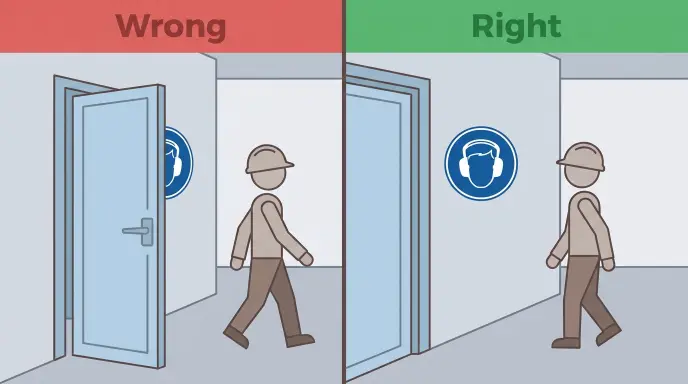
| Mistake | Fix |
|---|---|
| Sign hidden behind racking, stock or an open door | Move it to a clear wall at the point of decision (DM guideline, section F) |
| Ten signs crowded together | Keep one message per sign and remove signs for hazards that have gone (section H) |
| Faded, cracked or half-peeled signs left up | Replace them straight away (section M) |
| Signs only in a language few staff read | Add the language most staff understand (section E) |
| One big board at the entrance meant to cover the whole building | Put each sign at its own hazard |
That last one comes up often. A single board at the door cannot do the job. Each sign needs to be at the hazard it warns about.
How often should workplace safety signs be checked and replaced?
Check signs as part of your regular safety walks, and replace any damaged, worn, missing or faulty sign straight away. Dubai Municipality requires immediate replacement and asks employers to keep maintenance records for its inspectors (DM guideline, section M). Lit signs need a guaranteed power supply or a backup.
Training is part of the same duty. In Dubai, staff must be trained on safety signs at least once a year, and training records must be kept for at least five years (section N). If you would rather hand the upkeep to someone else, our signage maintenance team can take it on.
Custom safety signs made in the UAE
Bab Al Mashriq designs and prints bilingual ISO 7010 safety signs, photoluminescent signs, accident prevention tags, barricade banners and safety boards in our Ajman workshop, for sites and workplaces across the UAE. Exit and evacuation signs that must be installed by a Civil Defence-approved contractor go through an approved installer.
Related safety sign guides
- How safety signs prevent accidents on construction sites
- Mandatory safety signs for construction sites in the UAE
Workplace safety sign FAQs
What are the 5 main safety signs?
Prohibition, warning, mandatory, emergency and safe condition, and fire safety signs. Each has its own shape and colour under ISO 7010.
What are mandatory signs in the UAE?
Mandatory signs show an action you must take, such as wearing eye protection. They are blue circles with a white symbol.
Are Arabic and English required on workplace safety signs in Dubai?
The DM guideline asks for a language that most of the workforce understands, with Arabic and English as examples. Construction sites in Dubai must use Arabic, English and the language most workers know.
Can one safety sign board cover the whole workplace?
No. Signs must be placed at each hazard, where people make the decision, far enough away to give them time to react.
Who inspects safety signs at work?
In Dubai, Dubai Municipality’s occupational health and safety inspectors. In Sharjah, the Sharjah Prevention and Safety Authority (SPSA). In Abu Dhabi, the authorities under the ADOSH-SF framework.
Do offices need safety signs?
Yes. Offices need exit and fire equipment signs, first aid and assembly point signs, and temporary signs such as wet floor warnings.
Who can install exit signs?
In DMCC, only a Civil Defence-approved contractor under a Civil Defence-approved consultant. Check the rule with the authority for your own zone.
Get your workplace safety signs made
Workplace safety signs in the UAE work when they come from a real risk assessment, use symbols and languages your staff understand, and stay in good condition. Tell us your workplace type and we will put together the sign set from this checklist, printed in our Ajman workshop. Get a free quote on WhatsApp or call 055 397 5597, or contact us online.